What if the platform you chose to accelerate growth is quietly throttling your digital architecture? Weighing hubspot cms vs custom web development for complex integration is rarely just a debate over marketing convenience; it fundamentally determines how freely your data can move across your tech stack. It's natural to appreciate turnkey convenience and ready-to-use workflows. Still, running into rigid API rate limits, struggling to sync bespoke databases to proprietary fields, and facing ballooning subscription costs creates real operational friction.
You shouldn't have to compromise core business logic simply to fit within a vendor's prepackaged boundaries. This analysis will help you discover whether HubSpot CMS or custom web development delivers the architectural power, API flexibility, and scalability required for complex integrations. Together, we'll establish a practical architectural evaluation framework and pinpoint the exact thresholds where proprietary CMS suites break down, ensuring you select a scalable development strategy that guarantees complete system sovereignty.
Key Takeaways
- Understand how backend architectures diverge when weighing hubspot cms vs custom web development for complex integration, particularly around database freedom and deep system connectivity.
- Uncover how proprietary API rate limits, burst thresholds, and rigid payload constraints can throttle high-concurrency enterprise data synchronisation.
- Discover the tangible impact that dynamic third-party API calls and middleware dependencies have on page rendering speed and regulatory compliance.
- Use a structured evaluation framework to assess your team's development capabilities, integration throughput demands, and long-term licensing costs.
- See how bespoke software engineering and tailored CMS platforms deliver complete architectural sovereignty without recurring tier penalties.
Architectural Fundamentals: HubSpot CMS vs Custom Web Development for Deep System Connectivity
Modern enterprise applications thrive on continuous, real-time data exchange. Whether synchronizing ERP inventory, processing telemetry from proprietary hardware, or communicating with legacy financial engines, your web tier acts as the central interface. Choosing between hubspot cms vs custom web development for complex integration shapes your entire engineering trajectory, setting hard boundaries on system agility and architectural sovereignty for years to come.
At its core, a standard Content Management System separates digital content authoring from delivery layers. However, how platforms handle deep system connectivity reveals stark operational differences.
The Monolithic SaaS Paradigm: How HubSpot CMS Handles External Data
HubSpot CMS (repositioned within Content Hub) bundles web hosting, templates, and serverless functions directly with its proprietary CRM. Rendering external data relies on HubL markup or embedded React components interacting with serverless endpoints.
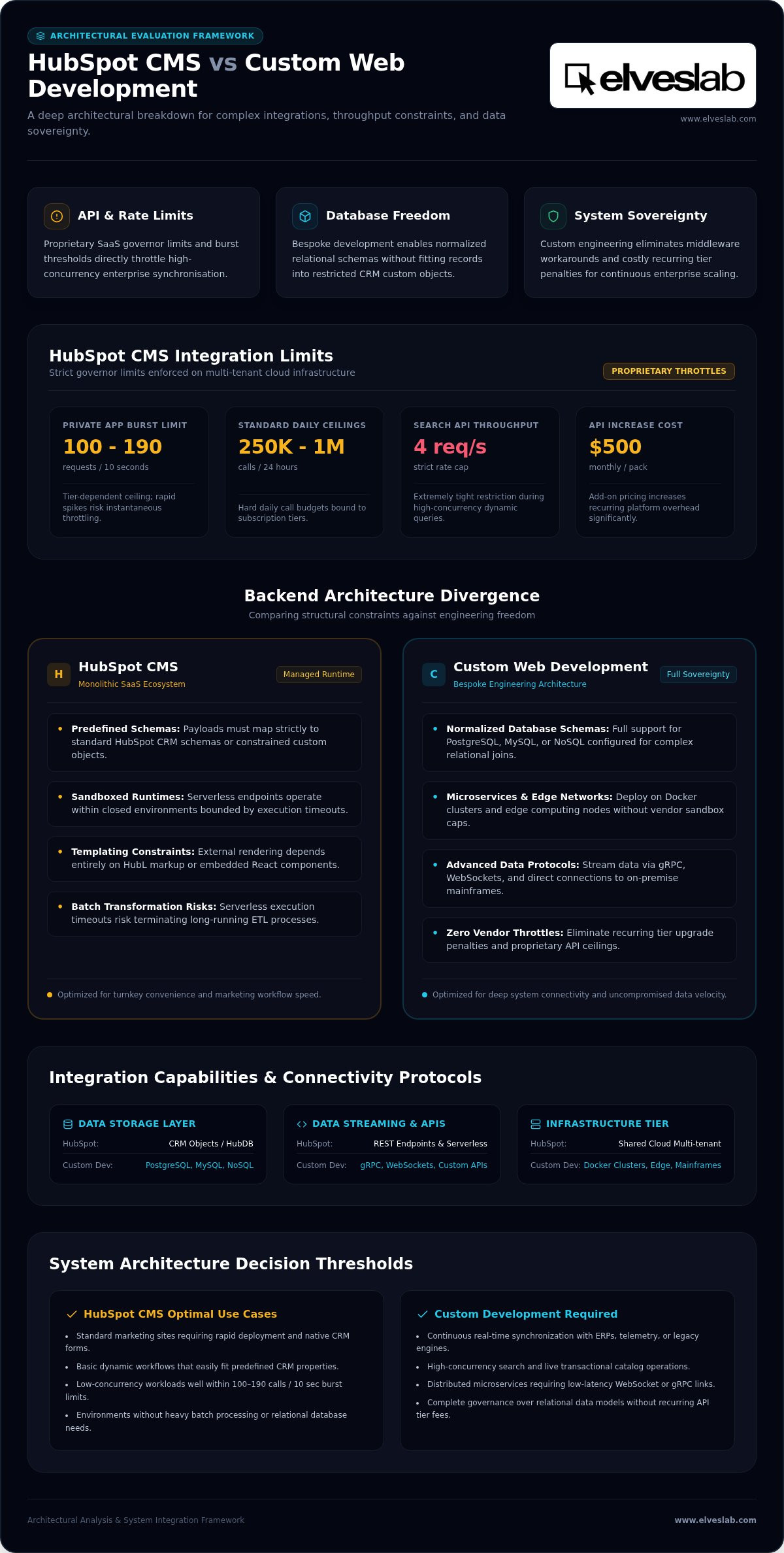
This managed ecosystem provides rapid deployment for marketing teams, but it forces your backend logic into a closed box. External payloads must map directly to predefined HubSpot CRM schemas or constrained custom objects. Integration scripts execute inside sandboxed runtime environments governed by rigid platform execution timeouts. If your workflows require multi-layered relational joins, distributed queue handling, or complex data transformations, the SaaS abstraction layer quickly morphs from a helpful guardrail into a bottleneck.
The Custom Web Development Approach: Unrestricted Engineering Freedom
Custom engineering discards vendor-enforced conventions entirely. Instead of reshaping unique operational records to fit third-party fields, engineers build tailored architectures around your exact business requirements. This freedom unlocks significant advantages:
- Normalized Database Schemas: Design high-performance PostgreSQL, MySQL, or NoSQL databases configured specifically for your multi-source transactional flows.
- Microservices and Edge Computing: Route traffic across isolated microservices, Docker clusters, or edge networks without sandbox execution caps.
- Direct System Interoperability: Connect deeply with on-premise mainframes, custom APIs, and third-party SaaS tools using optimized protocols like gRPC or WebSocket streaming.
Bespoke architectures eliminate middleware workarounds and provide lasting system governance. You can explore the broader technical and commercial advantages of building from the ground up in our custom web design guide.
Deciding the contest between hubspot cms vs custom web development for complex integration ultimately rests on data velocity. When your architecture demands uncompromised data integrity across bespoke services, full engineering ownership wins out.
Technical Integration Constraints: API Limits, Data Synchronization, and Backend Logic
High-concurrency digital platforms live and die by backend throughput. When thousands of users trigger concurrent inventory reservations, search catalog items, or submit dynamic applications, your underlying infrastructure must process data without latency spikes. Evaluating hubspot cms vs custom web development for complex integration requires inspecting how each environment behaves when traffic surges and API quotas are tested.
API Throttling and Governor Limits in HubSpot CMS
HubSpot enforces strict governor limits to protect its shared multi-tenant cloud. For private apps, burst limits cap traffic at 100 to 190 requests per 10 seconds depending on subscription tier, with standard daily ceilings between 250,000 and 1,000,000 calls. The Search API is even tighter, restricted to just 4 requests per second.
If your web application triggers high-frequency ERP lookups, rapid live queries can hit these thresholds instantly. While you can purchase API limit increase add-ons at $500 monthly per pack, proprietary rate throttling remains a permanent architectural ceiling. Furthermore, serverless execution timeouts terminate long-running processes, making deep batch transformations risky without external middleware.
Data Modeling Flexibility: Custom Objects vs Relational Databases
HubSpot lets you build custom objects to represent non-standard data, but structural restrictions still apply. You face schema definition boundaries, finite relationship associations, and limited indexing controls. Complex multi-table joins and polymorphic relations can quickly strain the interface.
Custom SQL and NoSQL engines offer complete data modeling freedom. Developers can design normalized database clusters, construct custom indexes, and execute sub-millisecond ACID transactions without hitting platform limits. For high-volume transactional pipelines, exploring dedicated web application development ensures your data schema mirrors your exact operational reality.
Event-Driven Architectures and Real-Time Bidirectional Synchronization
Real-time data synchronization between disparate enterprise systems demands resilience. HubSpot provides workflow webhooks to notify external endpoints when properties change, yet it lacks built-in message queuing or dead-letter retries when destination endpoints fail.
Custom software engineering solves this by implementing resilient message brokers:
- Asynchronous Message Queues: Tools like RabbitMQ, Apache Kafka, or Redis buffer millions of incoming transactions without dropping packets during downtime.
- Granular Error Handling: Automated retry policies and dead-letter queues capture failed events for inspection without corrupting master records.
- Direct Connection Pooling: Direct database connections bypass HTTP overhead entirely, reducing serialization delays across internal microservices.
When enterprise systems require frictionless communication across proprietary toolsets, collaborating with custom software development specialists ensures your stack handles intense traffic without artificial throttling.
Every dynamic query across an integration bridge carries computational overhead. When user requests trigger simultaneous lookups against external accounting engines or inventory nodes, your infrastructure's architecture dictates whether pages load instantaneously or crawl to a halt. Analyzing hubspot cms vs custom web development for complex integration means looking closely at how data transit affects response speed, cryptographic sovereignty, and strict regulatory governance.
Frontend Performance and Headless Edge Caching Strategies
HubSpot delivers exceptional content delivery network caching for static assets. The challenge arises when pages rely heavily on dynamic, personalized datasets pulled from outside systems. HubSpot serverless functions must complete external API handshakes before serving rendered HTML, which directly inflates Time to First Byte (TTFB).
Custom engineering prevents this rendering latency by decoupling computation from the delivery tier:
- Edge-Side Rendering and ISR: Modern meta-frameworks like Next.js enable Incremental Static Regeneration, serving pre-rendered pages from edge caches while updating dynamic records in the background.
- Granular Hydration: Custom frontends hydrate only interactive user elements, reducing initial JavaScript execution costs.
- Direct Redis Layering: Memory caches sit directly in front of backend databases, fulfilling frequent relational queries in single-digit milliseconds.
These techniques allow portals to manage massive concurrent query volumes without sacrificing Core Web Vitals or interface responsiveness.
Data Sovereignty, Zero-Trust Security, and Compliance Governance
HubSpot provides robust, turnkey defense perimeters, including SOC 2 Type II compliance, automated patching, and managed Web Application Firewalls. These protections suit standard marketing initiatives, but SaaS platforms inherently store synchronized customer records within multi-tenant global cloud environments.
Certain enterprise use cases cannot compromise on physical data residency or multi-tenant hosting. Highly regulated sectors like healthcare, government technology, and financial services often face strict statutory mandates requiring complete isolation. Custom web platforms allow organizations to deploy across sovereign, single-tenant private cloud instances or secured on-premise clusters. Engineering teams retain total control over zero-trust networking perimeters, custom hardware security modules, and granular field-level encryption algorithms.
When measuring hubspot cms vs custom web development for complex integration, security is about governance, not just shielding against brute-force intrusion. Total architectural ownership ensures you dictate exactly where sensitive enterprise records reside, how they're encrypted, and who holds the keys.
Decision Framework: How to Evaluate Your Organization’s Integration Needs
Selecting between hubspot cms vs custom web development for complex integration is an economic decision as much as a technical one. While marketing teams often favor turnkey platforms for their rapid launch speed, engineering leadership must evaluate five-year architectural costs, operational limitations, and data ownership. To make an objective choice, run your planned stack through a systematic audit before committing resources.
Step-by-Step Assessment: Auditing Data Endpoints and Business Logic
Begin by mapping every digital touchpoint that touches your web tier. Many organizations underestimate their integration density until sync failures begin occurring in staging.
- Audit System Endpoints: Inventory every ERP, CRM, third-party logistics platform, billing gateway, and proprietary tool requiring communication with your site.
- Calculate Concurrency Requirements: Estimate average daily call volumes alongside expected peak transactions per second during marketing promotions.
- Map Unique Business Rules: Check if your operational workflows require non-standard relational structures that resist SaaS serialization. High-volume retail transactions require specialized synchronization patterns, as examined in our scalable e-commerce development analysis.
- Evaluate Internal Development Resources: Determine whether your in-house team holds specialized skills in proprietary SaaS markup languages or broad experience in modern open-source stacks.
Total Cost of Ownership: Subscription Tiers vs Bespoke Asset Creation
Licensing models create dramatically different financial curves over time. HubSpot Content Hub Professional runs $450 monthly on an annual contract with three included seats, while Enterprise starts at $1,500 monthly with five seats. As operational demands expand across sales and operations, organizations often adopt Data Hub Professional at $800 monthly or Enterprise at $2,000 monthly, alongside mandatory onboarding packages ranging from $1,500 to $7,000 per hub.
When high query volumes necessitate multiple $500 monthly API add-on packs and external middleware subscriptions, recurring SaaS licensing can quickly surpass six figures over a four-year horizon. You are effectively renting technical capabilities that remain bound to a proprietary ecosystem.
Custom engineering alters this equation by concentrating capital expenditure upfront. Instead of accumulating permanent recurring platform overhead, your capital creates a wholly owned enterprise asset. You retain complete sovereignty over your database design, deployment infrastructure, and integration pipelines without penalty fees as your transactions multiply.
If you want to escape restrictive platform licensing and safeguard technical independence, schedule an engineering consultation with Elves Lab to design an unconstrained digital architecture tailored precisely to your operational needs.
Engineering Bespoke Integration Sovereignty: The Custom Development Solution
True digital independence comes from building an engine tailored to your exact operational realities. Settling the contest between hubspot cms vs custom web development for complex integration means deciding whether your company adapts to a platform's restrictions or commands a system engineered entirely around your goals. Bespoke development eliminates proprietary gatekeeping, giving engineering leaders total control over their data highways, security posture, and computational workflows.
Tailored Architecture Designed Around Your Core Operational DNA
Packaged solutions force developers to bend business logic to match rigid data models. Bespoke software engineering flips this paradigm completely. Instead of relying on middleware patches, custom platforms establish direct, uninterrupted pipelines between core enterprise components.
Taking this path gives your organization distinct technical advantages:
- Frictionless Data Pipelines: Connect proprietary databases, enterprise logistics, and billing systems without translation layers or serialization delays.
- Uncapped Scalability: Scale concurrent traffic, live database queries, and background computational jobs without confronting arbitrary tier caps or rate throttling.
- Architectural Ownership: Ensure your organization maintains full legal and technical governance over every line of code, database index, and server environment.
By bypassing third-party platform limitations, your engineering team can deploy features on your schedule rather than waiting for vendor updates.
Long-Term Strategic Scalability with Elves Lab
Building high-performance architectures requires proven engineering craftsmanship. Established in 2000, Elves Lab builds scalable digital foundations from scratch rather than forcing growing organizations into restrictive templates. Our team unifies custom web design, specialized CMS implementations, custom software development, and high-reliability web hosting into seamless, robust ecosystems.
We work as an invested technical partner from initial architectural blueprints through system deployment and ongoing hosting management. Rather than letting proprietary tools dictate your development ceiling, we construct digital platforms that adapt as your operational requirements expand.
When your tech stack demands uncompromised throughput, custom database design, and ironclad data sovereignty, bespoke engineering provides the definitive path forward. Ready to build without architectural limits? Consult our custom web development specialists to start architecting your dedicated solution today.
Reclaim Digital Sovereignty and Scale Without Architectural Limits
Navigating the decision between hubspot cms vs custom web development for complex integration ultimately comes down to one core reality: your infrastructure should expand your business capabilities, not constrain them. Turnkey SaaS platforms excel at fast launches and standard marketing funnels. However, intricate enterprise connectivity demands unrestricted database schemas, resilient event-driven message queues, and predictable long-term costs free from escalating tier penalties.
Owning your software ensures you never have to re-engineer your core business workflows around vendor limits. Founded in 2000, Elves Lab draws on over two decades of bespoke software development, custom CMS engineering, and secure web hosting experience. We partner with ambitious organizations to transform complex multi-system environments into intuitive, high-speed digital assets built for lasting independence. Ready to eliminate platform bottlenecks and engineer an uncompromised digital engine? Discuss your complex integration architecture with Elves Lab today, and let's build an agile foundation that supports your vision for years to come.
Frequently Asked Questions
Can HubSpot CMS handle real-time inventory and bi-directional ERP data synchronization?
HubSpot CMS can handle basic bilateral sync through Data Hub connectors, but it struggles with high-concurrency real-time inventory updates. Burst rate caps and payload thresholds can delay sync jobs during high-traffic events. Custom web development bypasses these limits by using persistent socket connections and direct database pooling, ensuring inventory levels match your ERP instantaneously across all user sessions without queuing bottlenecks.
What are the primary API rate limits to consider when using HubSpot CMS?
HubSpot restricts standard private apps to burst limits of 100 to 190 calls per 10 seconds, depending on your subscription tier. Daily allowances range between 250,000 and 1,000,000 calls, while the Search API caps throughput at just 4 requests per second. Evaluating hubspot cms vs custom web development for complex integration highlights how custom architectures avoid these caps through optimized, direct database queries.
When does custom web development become more cost-effective than HubSpot CMS?
Custom engineering becomes more cost-effective when recurring SaaS licensing, API add-on packs, and seat fees exceed long-term maintenance costs. Content Hub Enterprise starts at $1,500 monthly, and adding Data Hub plus multiple $500 monthly API packs quickly inflates operational expenses. Custom development concentrates capital into a permanent enterprise asset that your organization owns outright, eliminating escalating annual platform penalties as your transactions scale.
Can I use HubSpot CRM while running a completely custom-built website?
Yes, you can integrate HubSpot CRM with a custom-engineered web platform through targeted API webhooks. This hybrid architecture gives you the best of both worlds. Your marketing team retains access to HubSpot lead scoring and CRM contact management, while your website runs on a sovereign, ultra-fast custom backend. Bespoke middleware batches non-critical CRM updates asynchronously, protecting web performance while avoiding real-time API rate throttles.
How does page speed and SEO performance compare between HubSpot CMS and custom development?
Custom development consistently outperforms HubSpot CMS on dynamic page speed and technical SEO flexibility. While HubSpot caches static assets effectively, dynamic data calls trigger serverless roundtrips that delay Time to First Byte. Custom architectures leverage edge-side rendering, selective hydration, and finely tuned Redis caches. This level of optimization maximizes Core Web Vitals scores and gives you complete control over structured data markup.
What security and compliance limitations should enterprise organizations watch for in HubSpot CMS?
The primary security limitation is HubSpot's shared multi-tenant cloud model, which prevents single-tenant physical data residency. Highly regulated organizations facing strict financial or healthcare compliance rules often require dedicated cryptographic hardware and isolated sovereign servers. Custom platforms let you enforce strict zero-trust perimeters, field-level database encryption, and isolated hosting environments that meet exact statutory standards without relying on multi-tenant SaaS trust boundaries.
Is vendor lock-in a significant concern when scaling complex integrations on HubSpot CMS?
Vendor lock-in is a serious strategic risk when building deep integrations on HubSpot CMS. Workflows built around proprietary HubL code, custom objects, and ecosystem modules don't transfer to other hosting environments. Migrating away later usually requires an expensive rebuild from scratch. Comparing hubspot cms vs custom web development for complex integration underscores the value of open-source frameworks, which ensure long-term code portability and technical independence.
Disclaimer
AI-Generated Content Disclaimer
The articles, blog posts, and informational content published on this website may be generated or assisted by artificial intelligence (AI) tools for search engine optimisation (SEO), content discovery, and informational purposes.
While reasonable efforts are made to ensure the content is relevant and useful, the information provided may not always be accurate, complete, current, or applicable to your specific circumstances. The views, opinions, statements, recommendations, or interpretations expressed in these articles are generated based on publicly available information and do not necessarily reflect the views, opinions, positions, policies, or professional advice of our company, its management, employees, partners, or affiliates.
The content should not be construed as legal, financial, medical, technical, professional, or other specialised advice. Readers are encouraged to independently verify any information and seek professional consultation where appropriate before making decisions based on the content provided.
Our company shall not be held liable for any loss, damage, claim, or consequence arising directly or indirectly from the use of, reliance upon, or interpretation of any AI-generated content published on this website.
By accessing and using this website, you acknowledge and accept that certain content may be generated or assisted by AI technologies and is provided on an "as is" basis for informational and SEO purposes only.