The cheapest ecommerce web packages sell you a shiny checklist of features, but high-ROI online stores are engineered as scalable business assets. If you feel overwhelmed comparing agency proposals packed with confusing jargon, rigid templates, and vague promises about code ownership, you aren't alone. Nobody wants to invest in a digital storefront only to discover that sluggish mobile loading speeds and mounting third-party plugin fees make scaling impossible within twelve months.
Building an ambitious brand requires complete clarity, not costly guesswork. In this guide, you'll discover how to evaluate ecommerce web packages with precision, avoid hidden recurring integration costs, and choose an architecture engineered for sustainable revenue. We break down the exact blueprint you need to compare competing development proposals, secure transparent operational costs, and deploy a fast, high-converting checkout experience built to scale smoothly alongside your business.
Key Takeaways
- Learn how to evaluate ecommerce web packages by identifying essential technical inclusions and weeding out vague agency jargon.
- Discover the true total cost of ownership by uncovering hidden transaction fees, maintenance overheads, and recurring plugin subscriptions.
- Compare off-the-shelf template setups against custom development architectures across performance, intellectual property ownership, and scalability.
- Follow a practical 5-step vetting framework to align package scope with your catalog volume, checkout workflow, and long-term business goals.
Understanding Ecommerce Web Packages: Core Components and Modern Realities
An ecommerce package isn't just a design theme bundled with a few product upload forms. At its core, a complete package delivers a coordinated suite of custom web design, secure database architecture, Content Management System (CMS) configuration, and high-performance hosting. Instead of wrestling with fragmented freelance contracts, businesses choose packaged solutions to unify their technical roadmap under a single accountable team. When examining what is e-commerce in modern practice, commercial success hinges on technical stability far more than superficial polish.
Online retail has evolved beyond basic digital storefronts. Visual aesthetics grab attention, but high-converting stores rely on speed-optimized infrastructure and headless flexibility to drive transactions. Modern shoppers abandon slow checkouts without hesitation. A resilient architecture guarantees that sudden traffic surges, marketing campaigns, and catalog expansions never degrade your site's speed or security posture.
The Essential Anatomy of an Ecommerce Package
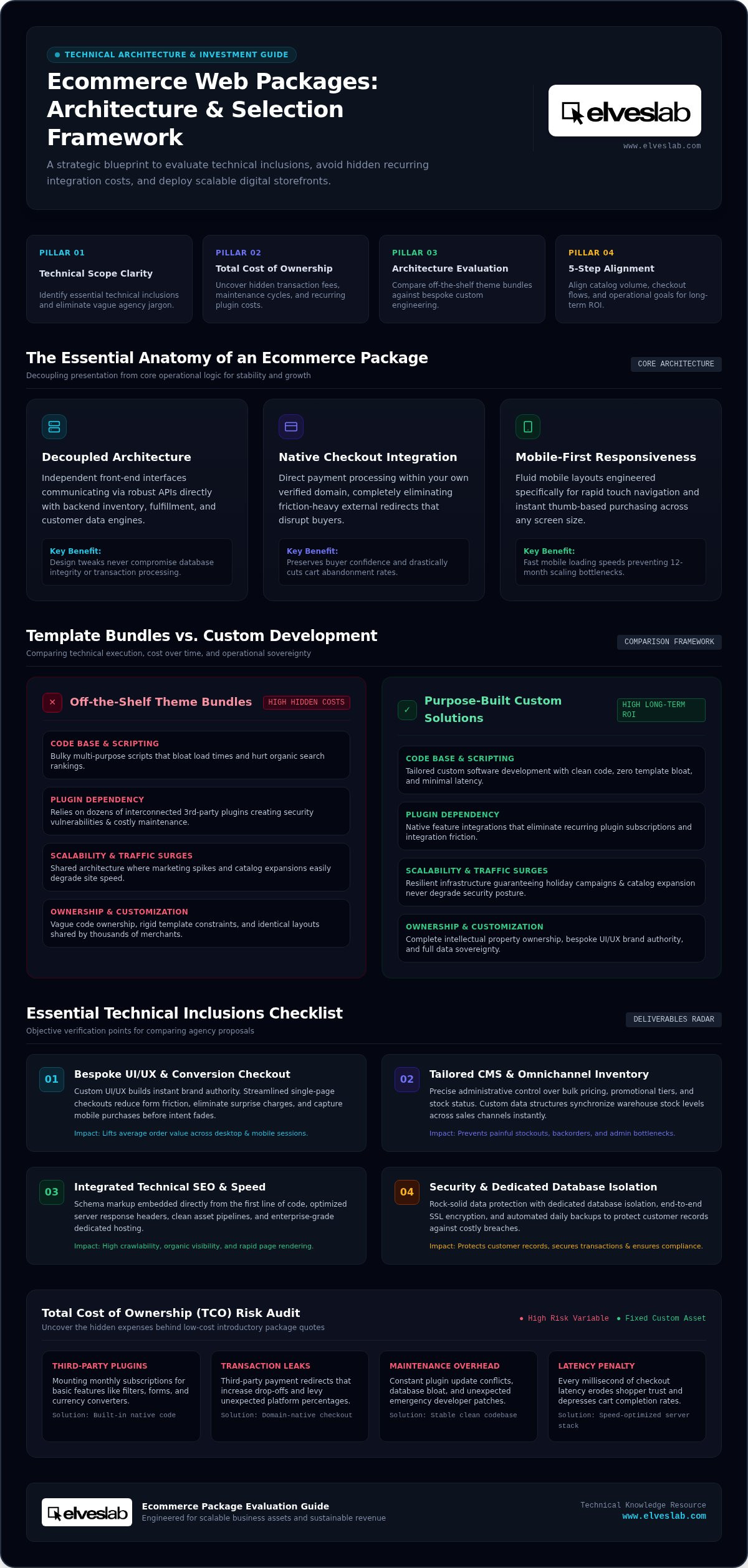
Modern ecommerce web packages cleanly decouple presentation from operational logic. This separation ensures front-facing design tweaks never compromise your core database. Every high-performing build requires:
- Decoupled architecture: Independent front-end interfaces communicating via APIs with backend inventory, fulfillment, and customer data engines.
- Native checkout integration: Direct payment processing within your domain, eliminating friction-heavy external redirects that disrupt buyers.
- Mobile-first responsiveness: Fluid mobile layouts engineered for rapid touch navigation and instant thumb-based purchasing.
Turnkey Templates vs. Purpose-Built Custom Solutions
Pre-packaged off-the-shelf theme bundles look convenient at first glance. However, they rely on bulky multi-purpose scripts that bloat load times and compromise search rankings. Relying on dozens of interconnected third-party plugins creates security vulnerabilities and costly maintenance cycles. In contrast, purpose-built ecommerce web packages tailor custom software development to your precise business operations. You get clean code, uncompromised speed, complete operational ownership, and zero template bloat.
Most commercial proposals overflow with marketing buzzwords, yet they gloss over the technical foundations that keep an online storefront profitable. Evaluating competing offers requires an objective checklist focused on revenue resilience. Superior ecommerce web packages deliver rock-solid data protection, dedicated database isolation, and automated daily backups, rather than merely handing over visual themes with pre-installed contact forms. Without secure transactional databases and end-to-end SSL encryption, your customer records remain vulnerable to costly breaches.
Technical execution determines your bottom line. Every millisecond of latency erodes shopper trust and depresses cart completion rates. That is why enterprise-level packages prioritize structural stability and data sovereignty over superficial decorations.
Bespoke UI/UX Design and Conversion-Centered Checkout
Generic theme setups force your products into identical layouts shared by thousands of competing merchants. Custom UI/UX design establishes instant brand authority, guiding prospective buyers effortlessly toward payment. Streamlined single-page checkouts reduce form friction, eliminate surprise charges, and capture mobile purchases before intent fades. This frictionless flow lifts average order values across both mobile and desktop sessions.
Tailored CMS and Omnichannel Inventory Architecture
As your catalog expands, basic admin panels become chaotic bottlenecks. Tailored Content Management Systems give operations teams precise control over bulk pricing, promotional tiers, and stock status without technical hurdles. Exploring modern strategies in e-commerce development highlights how custom data structures synchronize warehouse stock levels across multiple sales channels instantly, preventing painful stockouts and backorders.
Integrated Technical SEO, Speed, and Enterprise Hosting
Organic visibility requires deliberate technical engineering from the first line of code. Robust ecommerce web packages embed schema markup, optimized server response headers, and clean asset pipelines directly into your site structure. Combining dedicated web hosting with an aggressive ecommerce SEO strategy keeps your store fast, highly crawlable, and fully accessible during heavy holiday traffic spikes.
If you need an architectural review before committing your development budget, consulting with the specialists at Elves Lab Pte Ltd can help pinpoint the exact technical inclusions required for your store's growth stage.
Template Bundles vs. Custom Development: A Clear Comparison Framework
Selecting between entry-level template bundles and custom ecommerce web packages shapes your store's trajectory for years. While pre-made templates promise rapid deployment, they often trap scaling businesses in rigid code structures. In contrast, purpose-built architectures engineer every database query and user journey around your specific business model.
To help guide your evaluation, here is how the two approaches compare across core operational metrics:
| Operational Metric |
Turnkey Template Bundles |
Bespoke Custom Engineering |
| Initial Outlay |
Lower initial cash investment. |
Higher upfront capital commitment. |
| Code Ownership |
Restricted licenses or rented ecosystems. |
Full intellectual property ownership. |
| Speed & Bloat |
Heavy multipurpose scripts and plugin drag. |
Lean, custom-compiled execution. |
| Scalability |
Caps out quickly on large catalogs. |
Virtually limitless database scaling. |
| Security Control |
Vulnerable to mass public plugin exploits. |
Isolated environment and hardened endpoints. |
Analyzing the Total Cost of Ownership (TCO)
Low upfront package prices frequently hide staggering operational costs. A budget theme might cost very little on day one. Soon, you are paying hundreds of dollars each month for subscription plugins just to handle wholesale discounts, custom form fields, and abandoned cart automations. Third-party updates routinely break checkout flows, running up expensive developer troubleshooting hours. Relying on rented platform ecosystems leaves your business vulnerable to surprise transaction fee increases and difficult data migrations.
Scalability Limits and Custom Application Integrations
Standard themes hit technical walls fast when you introduce dynamic pricing rules, multi-tier B2B accounts, or complex fulfillment channels. You need reliable communication between your digital storefront and your external logistics partners. Custom software development solves this by connecting bespoke APIs directly to your Enterprise Resource Planning (ERP) systems, CRM pipelines, and third-party logistics (3PL) warehouses. Partnering with a dedicated agency for custom web design guarantees that your underlying code adapts smoothly as your order volume multiplies, protecting your revenue at every stage of expansion.
How to Evaluate and Select the Ideal Package for Your Business
Selecting the right digital development partner requires a disciplined vetting framework. Instead of falling for polished sales pitches, commercial leaders need an objective method to assess scope, operational fit, and long-term maintainability. Evaluating ecommerce web packages systematically prevents scope creep, protects capital, and ensures project delivery aligns with your business milestones.
Step 1 & 2: Audit Operational Requirements and Inventory Complexity
Begin by mapping internal logistics before requesting quotes. Document your exact SKU variations, localized GST requirements, and automated shipping workflows. Does your catalog demand simple attributes like size and color, or complex custom schemas for bundled kits? Establish concrete traffic benchmarks, including anticipated concurrent visits during major seasonal promotions. Clarifying these operational realities upfront keeps agency estimates realistic and shields your project against mid-build scope inflation.
Step 3 & 4: Vetting Agency Expertise and Technical Architecture
Never judge an agency solely on visual mockups. Dig into their technical portfolio to confirm direct experience engineering bespoke software and high-volume transaction engines. Ask direct questions: Who owns the repository once final payment clears? Will custom database schemas remain portable? Your business must retain complete rights to your source code and customer data. For stores with unique customer portals or custom pricing logic, review how tailored web application development delivers structural flexibility that standard platforms cannot provide.
Step 5: Reviewing Post-Launch Support, Security, and Hosting SLA
A digital launch marks the beginning of your store's commercial lifecycle, not the end. Demand enforceable Service Level Agreements (SLAs) covering uptime commitments, database integrity audits, and emergency server response times. Confirm routine security patching protocols to protect sensitive customer data against modern cyber threats. Comprehensive ecommerce web packages should also provide clear expansion pathways, including ongoing search optimization and performance tuning.
Ready to build an online store on a rock-solid technical foundation? Schedule a strategic consultation with Elves Lab to blueprint your bespoke digital build today.
Maximizing Store ROI: Why Bespoke Ecommerce Engineering Powers Long-Term Success
Viewing web development as a one-off business expense limits your commercial upside. When engineered correctly, bespoke ecommerce architecture acts as an appreciating digital asset that builds lasting equity for your brand. Tailored shopping platforms boost customer retention by delivering intuitive interactions, personalized merchandising, and zero checkout delays. By eliminating arbitrary platform constraints, you gain full autonomy over customer journeys, data ownership, and pricing experiments.
Long-term profitability depends on technical cohesion. Juggling disconnected vendors for hosting, development, and digital marketing inevitably creates communication gaps and technical debt. Consolidating these disciplines under a seasoned development partner ensures every database optimization, UX improvement, and campaign strategy works toward the same commercial objective.
Engineering Speed and Brand Exclusivity for Market Leadership
Sub-second page speeds directly protect your marketing spend. Rapid load times maximize return on ad spend (ROAS) by preventing paid traffic from bouncing before products even render. Beyond pure speed, custom layouts build immediate buyer trust, setting your brand apart from competitors trapped in recognizable off-the-shelf theme structures. A tailored codebase also gives you the agility to connect emerging digital sales channels, headless touchpoints, or social storefronts without rebuilding your foundation from scratch.
Partnering with Elves Lab for Sustainable Ecommerce Growth
Navigating modern retail requirements demands proven technical mastery. Since 2000, Elves Lab has delivered bespoke software engineering, enterprise-grade ecommerce development, and tailored Content Management Systems built from scratch. Rather than locking businesses into restrictive templates, their dedicated architectures prioritize speed, airtight security, and operational freedom.
Elves Lab provides end-to-end capabilities under one roof to support your long-term roadmap:
- Custom UI/UX & Web Design: Purpose-built digital storefronts engineered around your specific buyer journeys.
- Bespoke Software & CMS: Tailored backend tools that simplify complex inventory workflows and multi-tiered pricing rules.
- Secure Dedicated Hosting: High-uptime web hosting environments configured specifically for fast transaction processing.
- Search Visibility & Content: Integrated SEO frameworks and cutting-edge AI video generation to capture and convert organic demand.
Stop settling for rigid templates that limit your brand's potential. If you are ready to build a fast, scalable online store engineered for lasting revenue, take the next step and consult Elves Lab for custom ecommerce packages tailored to your commercial vision.
Architect Your Store for Sustainable Commercial Growth
Choosing between competing ecommerce web packages shouldn't feel like a high-stakes gamble. Long-term digital success requires looking past superficial feature checklists to secure true code ownership, sub-second checkout speeds, and scalable inventory architecture. When you move beyond rigid, plugin-heavy templates and treat your online store as an appreciating business asset, every operational workflow works directly in service of higher revenue and customer loyalty.
Navigating this technical evolution is much easier with the right partner by your side. With over two decades of proven digital design and bespoke software development experience since 2000, Elves Lab provides comprehensive in-house capabilities spanning custom CMS development, SEO optimization, and secure web hosting. Ready to build a digital platform engineered to scale effortlessly alongside your ambitions? Accelerate your digital sales with a custom ecommerce package from Elves Lab and unlock your store's true commercial potential.
Frequently Asked Questions
What is typically included in a professional ecommerce web package?
A professional ecommerce web package delivers an end-to-end commercial system rather than just a visual skin. Core inclusions feature custom frontend UI/UX design, tailored backend database architecture, a Content Management System (CMS), and native payment processing gateways. Comprehensive packages also bundle foundational technical SEO setup, security hardening, automated data backups, and reliable web hosting to guarantee high checkout performance from day one.
How do I know if my business needs a custom ecommerce build instead of a template?
You need a custom build when standard theme options restrict your daily operations or damage your brand identity. Clear indicators include managing multi-tiered B2B pricing, requiring direct integrations with proprietary ERP or warehouse systems, or handling large product catalogs that cause template slowdowns. Custom development gives you total code ownership and unlimited operational flexibility, ensuring your store never hits an artificial technical ceiling.
Are web hosting and domain registration usually included in ecommerce packages?
Established digital agencies frequently incorporate high-performance web hosting into their packages, while domain names remain registered directly by the merchant. Maintaining domain ownership protects your business equity and data rights. Bundling dedicated web hosting directly with your development partner ensures optimized server response times, proper database caching, and seamless staging environments configured specifically for high-volume transactions.
How long does it take to develop and launch an ecommerce website using an agency package?
A bespoke ecommerce project typically takes between eight and sixteen weeks to engineer, test, and launch. The timeline depends entirely on backend complexity, custom data integrations, and catalog depth. Turnkey templates launch faster, but tailored ecommerce web packages follow a structured workflow encompassing user journey wireframing, custom software engineering, payment sandbox testing, and rigorous cross-device quality assurance before deployment.
What hidden costs should businesses watch out for in cheap ecommerce packages?
Budget offers routinely exclude critical functionalities that trigger recurring expenses later. Watch out for mandatory monthly fees for third-party plugins, third-party payment gateway surcharges, and high hourly rates for basic maintenance. Inexpensive bundles also frequently omit essential security patching, transactional email setup, and server optimization, forcing you to pay premium troubleshooting costs as soon as order volumes rise.
Can an ecommerce web package integrate with existing ERP, POS, and warehouse systems?
Yes, professional bespoke packages are built specifically to connect with your existing operational software. Experienced agencies develop custom RESTful APIs and middleware to bridge your storefront with internal inventory management, point-of-sale terminals, and 3PL fulfillment hubs. This synchronization eliminates manual data entry, prevents accidental overselling across retail channels, and automates tracking updates for your customers in real time.
Will my team be able to manage products and content easily without coding knowledge?
A well-architected store includes an intuitive, custom Content Management System tailored to your specific administrative workflow. Your operations team can easily update product variants, adjust retail pricing, manage discount codes, and publish promotional banners without touching code. Clear, modular input fields ensure your internal staff maintains complete day-to-day control while preserving the site's underlying technical layout and speed.
How do ecommerce web packages ensure website security and protect customer payment data?
High-tier ecommerce web packages maintain rigorous security through isolated hosting environments, end-to-end SSL encryption, and compliance with PCI DSS standards. Sensitive payment details are processed directly via secure, tokenized API endpoints rather than stored on your primary web server. Regular vulnerability scanning, automated daily database backups, and script integrity checks protect your platform and customer transactions against digital skimming threats.
Disclaimer
AI-Generated Content Disclaimer
The articles, blog posts, and informational content published on this website may be generated or assisted by artificial intelligence (AI) tools for search engine optimisation (SEO), content discovery, and informational purposes.
While reasonable efforts are made to ensure the content is relevant and useful, the information provided may not always be accurate, complete, current, or applicable to your specific circumstances. The views, opinions, statements, recommendations, or interpretations expressed in these articles are generated based on publicly available information and do not necessarily reflect the views, opinions, positions, policies, or professional advice of our company, its management, employees, partners, or affiliates.
The content should not be construed as legal, financial, medical, technical, professional, or other specialised advice. Readers are encouraged to independently verify any information and seek professional consultation where appropriate before making decisions based on the content provided.
Our company shall not be held liable for any loss, damage, claim, or consequence arising directly or indirectly from the use of, reliance upon, or interpretation of any AI-generated content published on this website.
By accessing and using this website, you acknowledge and accept that certain content may be generated or assisted by AI technologies and is provided on an "as is" basis for informational and SEO purposes only.