What if the website that looks cheapest to launch becomes the most expensive to grow? Corporate website development in 2026 is about more than choosing a polished template. A site that cannot keep pace with your business may bring rebuild costs, complicate search performance, and leave security gaps that put trust at risk.
A fast, cost-conscious launch is a reasonable goal. But your corporate website should also support your team’s workflows, connect with relevant business systems, and adapt as your needs change. The key is choosing an approach that fits your business instead of forcing it into a generic template.
This guide explains how to plan a corporate website around business goals, including architecture, CMS requirements, integrations, performance, and SEO. It also covers the decisions to make before development begins. Elves Lab provides custom web and software development, CMS, SEO, hosting, social media marketing, and AI video generation to help businesses plan connected digital services.
Key Takeaways
- See how corporate website development can grow beyond a static brochure into a digital platform that supports business goals.
- Compare custom development and templates by considering total cost of ownership, not just the initial build.
- Assess how brand-led UX and a tailored CMS can support consistent experiences and efficient content management.
- Use discovery, strategy, information architecture, and prototyping to turn business goals into a practical development roadmap.
- Know what to ask a partner about web development, CMS, SEO, and hosting.
Defining Corporate Website Development in the AI-First Era
A corporate website once worked mainly as a digital brochure: it introduced a company, listed its services, and provided contact details. Today, it can also help prospects explore relevant information, submit enquiries, and take a clear next step. Effective corporate website development connects that visitor experience to the goals and systems behind the business.
Bespoke development means shaping a website’s design, content structure, and functionality around specific requirements instead of adapting the business to a pre-built theme. For a larger organisation, this might include a tailored CMS, connections to existing software, and an architecture that can accommodate new teams, services, or workflows. A high-level introduction to Web development explains how front-end experiences and back-end systems work together.
AI can add useful capabilities, but it is not a strategy on its own. A strong digital presence still depends on thoughtful UI/UX, reliable performance, useful content, and technology that fits real business processes. For example, a company might use search-focused service pages to attract prospects, a defined process to route enquiries, and AI-generated video as an additional marketing format. Each element should support a clear business or user need.
The Core Objectives of a Modern Corporate Site
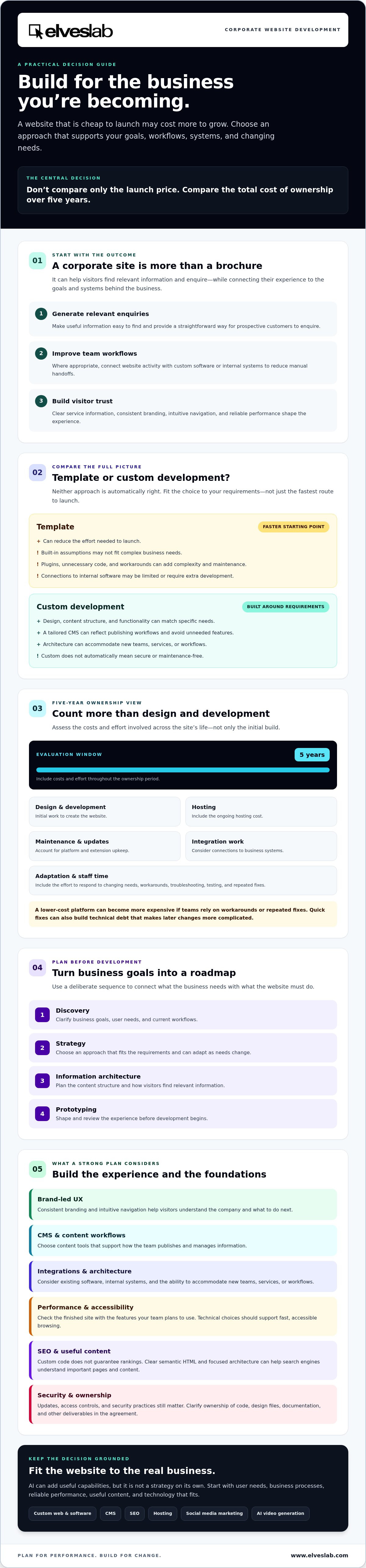
A corporate site should build trust with its intended audience. Clear service information, consistent branding, and intuitive navigation help visitors understand what the company does and what to do next. Set objectives that can guide both design and evaluation:
- Generate leads: Make relevant information easy to find and provide a straightforward way for prospective customers to enquire.
- Improve workflows: Where appropriate, connect website activity with custom software or internal systems to reduce manual handoffs.
These goals require more than attractive pages. The design needs to communicate credibility, while the underlying tools should help staff manage content and respond to enquiries efficiently.
Why Off-the-Shelf Solutions Can Fall Short for Enterprises
Templates can be a practical starting point, but their built-in assumptions may not fit complex business needs. Some designs and functions are difficult to adapt. Plugins or unnecessary code can also add complexity, so check how the finished site performs with the features your team plans to use. Technical choices should support fast, accessible browsing rather than make it harder.
Maintenance deserves equal attention. Platforms and third-party extensions need updates, and every added component can create more work to review and maintain. A purpose-built CMS can avoid features the organisation does not need and reflect its publishing workflows. Custom development is not automatically secure or maintenance-free. Access controls, updates, and security practices still matter. Choose an approach that fits the business you are building, not just the fastest route to launch.
Custom Development vs. Templates: Calculating Long-Term Business ROI
A template may reduce the effort needed to launch, but the initial build is only one part of the decision. To compare corporate website development options, assess total cost of ownership over five years. Include design and development, hosting, maintenance, updates, integration work, and the cost of adapting the site as business needs change. Factor in staff time, too. A lower-cost platform can become more expensive if teams depend on workarounds or repeated fixes.
Custom code does not automatically improve search rankings. Its potential advantage is greater control: developers can build around actual requirements, use clear semantic HTML, and avoid features the site does not need. A focused architecture can make important pages and content easier for search engines to understand. Responsive pages also give visitors a smoother experience, while slow or inconsistent browsing can frustrate them and weaken their impression of the company.
Custom software can also become a business asset. Before work begins, clarify who owns the code, design files, documentation, and other deliverables in the agreement. Confirming intellectual property (IP) rights helps the business understand what it can maintain, adapt, or reuse if its needs or development partner change.
The Hidden Costs of Free or Cheap Themes
Look beyond the theme price. A site that relies on several plugins may need careful coordination as each component is updated. If versions stop working well together, teams may face troubleshooting, testing, or replacement work. Technical debt can accumulate when quick fixes make future changes more complicated.
Pre-built solutions may also limit connections to internal software, or need extra development to support them. Check mobile layouts and accessibility using real content, not just a demo. A design that looks polished on a desktop preview may be difficult to use on smaller screens or with assistive technology.
Scalability: Growing Your Site with Your Business
Plan for the next stage of growth, not only launch day. A well-structured platform can make it easier to add e-commerce functionality without disrupting core pages, or to organise a CMS so different departments can manage relevant content. The right approach depends on the company’s workflows, permissions, and integration requirements.
Future-proofing does not mean building every possible feature now. It means choosing an architecture that can adapt. A company could add AI-generated video as a marketing format, for example, without rebuilding the entire site. Elves Lab offers custom web design, software development, CMS, SEO, hosting, social media marketing, and AI video generation. These services can be considered together when planning a digital solution. Review Elves Lab’s web development services as one starting point.
A high-performing corporate website needs more than a polished front end. Its design, content tools, security practices, hosting, and marketing foundations should work as one system for visitors and the teams who manage it. Plan these components together so new features strengthen the experience instead of creating disconnected workarounds.
Design for the brand and the user. Bespoke UI/UX should translate brand guidelines into clear navigation, consistent layouts, and useful page journeys. For example, a prospective client should be able to move from a service overview to relevant details and an enquiry form without searching through unrelated content. Clear design helps visitors understand the organisation and decide what to do next.
Plan for operational reliability. Choose hosting that suits the site’s technical and traffic requirements, then define how updates, backups, access, and security issues will be handled. Consider safeguards such as role-based access, secure authentication, and a planned update process. Security depends on ongoing practices as well as CMS and hosting choices, so clarify responsibilities before launch.
The Role of Custom CMS in Modern Operations
A custom CMS can reflect how departments work. Marketing may need to edit campaign pages, while other teams may only need access to approved sections. Define permissions for each role, then map the publishing process from draft and review to approval and release. This lets teams make routine updates while helping protect important site content.
If the business needs connections between the CMS and systems such as a CRM or ERP, first identify what information should move between them, who can access it, and what should happen if a connection fails. Clear requirements help avoid integrations that add complexity without improving a real workflow.
Digital Marketing Readiness: SEO and Social Integration
SEO starts with a sound page structure, not a last-minute plugin. Plan logical headings, descriptive page titles, crawlable navigation, clean URLs, and internal links that help people and search engines understand how content relates. Create dedicated landing pages for relevant audiences, and match each page to the questions and needs of its intended visitors.
Social media marketing should also be part of the publishing plan. Add appropriate sharing metadata and consider how new content can be prepared for social channels. Keep a human review step for accuracy and brand consistency. AI can support workflows without replacing judgement: a team might use AI video generation to create a marketing asset, then review its claims, accessibility, and fit before publishing. This connects content, SEO, social distribution, and AI while keeping the experience coherent and trustworthy.
Navigating the Corporate Web Development Lifecycle: A Buyer’s Roadmap
A clear process turns a website brief into a working business platform. The client’s role remains active throughout: share business context, make timely decisions, review deliverables, and confirm that the solution supports real users. Agree on decision-makers, approval steps, and project requirements early to keep the work aligned.
Phase 1: Strategy and Custom Requirements
Start with discovery. Bring together stakeholders from leadership, marketing, sales, IT, and any departments that will manage or rely on the site. Map the needs of key user groups, such as prospective customers looking for service information and staff updating content. Then translate business goals into technical requirements.
For custom software development, document the systems the website needs to connect with, the information that should move between them, and any access or workflow requirements. Define success measures before design begins. These could include qualified enquiries, completion of key user journeys, content publishing time, or organic search visibility. Make each KPI specific enough to review after launch.
Next, shape the information architecture. Organise pages around user needs and business priorities, then use wireframes or prototypes to show how visitors will move from an entry page to useful content and a clear next step. Validate terminology, content priorities, and internal requirements before these decisions become more costly to change during development.
Phase 2: Design, Build, and Launch
Once the structure is approved, designers develop the visual direction and refine it through feedback. Review representative pages against brand guidelines, mobile layouts, and expected content. Gather comments through agreed stakeholders so the team receives clear, actionable feedback rather than conflicting requests.
Development turns the approved experience into a functioning site. The team builds agreed features, configures the CMS, and implements planned software connections. Before launch, quality assurance should test core journeys across browsers and devices, including forms, links, permissions, integrations, and content display. Security checks should review access controls and the project’s agreed safeguards. Testing can identify and reduce defects, but no process should promise a completely bug-free system.
Plan the release with the client, not just the development team. Confirm hosting configuration, content responsibilities, migration steps, backups, and how existing URLs will be handled to avoid unnecessary disruption. After launch, review the agreed KPIs, address issues through the contracted arrangements, and refine SEO based on performance and search needs. Elves Lab offers custom development, CMS, SEO, and web hosting. Learn more about Elves Lab’s corporate website services.
Future-Proofing Your Digital Presence with Elves Lab
A corporate website should keep serving the business after launch, adapting as content, systems, and marketing priorities evolve. Elves Lab offers custom web and software development alongside CMS, SEO, web hosting, social media marketing, and AI video generation. Businesses can consider these capabilities together when planning a connected digital presence.
The Elves Lab Advantage: 26 Years of Bespoke Experience
Founded in 2000, Elves Lab has 26 years of experience creating custom digital solutions. Its services include bespoke development, custom software, and CMS integration shaped around practical requirements. The focus is on building around a business’s needs rather than fitting every project into a generic template.
For buyers, the useful question is not simply how long a provider has been in business. Ask how its experience applies to your requirements: Can the proposed CMS support your teams? Could custom software address a real workflow need? How will the site be maintained as the business changes? These questions connect a provider’s background to your goals for corporate website development.
Beyond Launch: Hosting, SEO, and AI Video
Development is one part of a lasting digital presence. Web hosting, SEO, and social media marketing can also be planned alongside the site. Clarify what hosting includes, how security responsibilities are handled, and what SEO work is planned. Hosting is an important foundation, but uptime and security depend on the specific setup and ongoing practices. Do not treat either as an automatic guarantee.
AI video generation can add another format to corporate storytelling. A company might use a short video to explain a complex service, introduce a capability, or support a campaign page. Keep the content grounded in approved facts and brand guidelines, and consider how it fits the page experience and marketing workflow. AI works best as a purposeful addition, not a substitute for clear messaging or thoughtful design.
If your organisation is planning its next digital step, bring business goals, system needs, and marketing priorities into one conversation with Elves Lab. This can help clarify which custom web, software, CMS, hosting, SEO, social media marketing, or AI video capabilities fit your plans.
Build a Digital Foundation for What’s Next
Your website can do more than represent your company. With a clear strategy, adaptable architecture, and thoughtful integration of design, software, SEO, and AI, corporate website development can create a stronger foundation for digital growth. Focus on the right fit for your workflows, not just the quickest route to launch, and plan for how the platform may evolve.
Elves Lab offers custom software development and digital services including web design, CMS, hosting, SEO, social media marketing, and AI video generation. The next step is to connect your business goals with an appropriate technical approach.
Contact Elves Lab to plan your bespoke corporate website. Start with your goals, workflows, and priorities to shape a practical development roadmap.
Frequently Asked Questions
What is the average timeline for custom corporate website development?
There is no reliable average timeline without knowing the project’s scope. A site with a clear structure and standard content differs from one requiring custom software, multiple system integrations, complex approvals, or a large content migration. For a realistic plan, ask for milestones covering discovery, design approval, development, content entry, testing, and launch. Your team’s availability for decisions and feedback can also affect the schedule.
How does custom web design improve my Google ranking in Singapore?
Custom design can support SEO by making it easier to build clear page structures, intuitive navigation, mobile-friendly layouts, and fast experiences around your audience’s needs. These choices help people use the site and help search engines interpret its content, but they cannot guarantee higher rankings. For Singapore-focused visibility, pair a technically sound site with relevant content, descriptive page titles, and ongoing SEO informed by search performance.
Can a corporate website be integrated with existing internal software?
A corporate website can often connect with internal software if the systems support a suitable integration method and the requirements are clear. Start by identifying what information needs to move, which system is the source of truth, and who should have access. For example, an enquiry form might pass lead details to a CRM. Elves Lab offers custom software development and bespoke CMS integration. Feasibility depends on the systems involved.
Why is a custom CMS better than using a standard WordPress template?
A custom CMS can be structured around your teams’ publishing tasks, access roles, and content types, rather than asking staff to work around a theme’s assumptions. A WordPress template can suit some needs, but templates and added plugins may introduce features or dependencies your organisation does not use. Neither option is automatically more secure. Compare flexibility, updates, integrations, ease of use, and who will maintain the chosen setup.
What are the security benefits of bespoke software development?
Bespoke software can be designed to include the features and access roles your business needs, which may help avoid unnecessary components. That does not make custom software secure by default. Security also depends on implementation, authentication, permissions, updates, hosting configuration, and ongoing review. Ask a development partner how these responsibilities will be handled, how sensitive information will be protected, and what process exists for addressing discovered vulnerabilities.
How much does corporate website development cost in 2026?
There is no single useful cost for every 2026 project. Confirm Elves Lab’s pricing directly rather than relying on industry estimates. Scope affects the estimate: page and content requirements, bespoke design, custom CMS or software, integrations, e-commerce functionality, migration, and testing all matter. Request a proposal that separates the initial build from hosting and any ongoing work, and states which deliverables and assumptions are included.
Does Elves Lab handle web hosting and maintenance after launch?
Elves Lab offers web hosting alongside custom web and software development, CMS, and SEO. Hosting can be planned as part of the broader website setup, but confirm the specific arrangements, responsibilities, and service scope for your project. Maintenance is not identified as a separate offering, so ask what post-launch updates or support, if any, are included in your agreement. Do not assume hosting automatically includes maintenance.
How can AI video generation enhance my corporate marketing strategy?
AI video generation can help turn a service explanation, company story, or campaign message into a video for relevant website pages and social media marketing. Begin with a specific audience and purpose, then review the script and finished content for factual accuracy, brand fit, and clarity. Video works best as one part of a broader content plan, supported by useful page copy and SEO, rather than as a replacement for them.
Disclaimer
AI-Generated Content Disclaimer
The articles, blog posts, and informational content published on this website may be generated or assisted by artificial intelligence (AI) tools for search engine optimisation (SEO), content discovery, and informational purposes.
While reasonable efforts are made to ensure the content is relevant and useful, the information provided may not always be accurate, complete, current, or applicable to your specific circumstances. The views, opinions, statements, recommendations, or interpretations expressed in these articles are generated based on publicly available information and do not necessarily reflect the views, opinions, positions, policies, or professional advice of our company, its management, employees, partners, or affiliates.
The content should not be construed as legal, financial, medical, technical, professional, or other specialised advice. Readers are encouraged to independently verify any information and seek professional consultation where appropriate before making decisions based on the content provided.
Our company shall not be held liable for any loss, damage, claim, or consequence arising directly or indirectly from the use of, reliance upon, or interpretation of any AI-generated content published on this website.
By accessing and using this website, you acknowledge and accept that certain content may be generated or assisted by AI technologies and is provided on an "as is" basis for informational and SEO purposes only.