Squarespace builds stunning visual showcases, but high-value sales pipelines demand an entirely different caliber of digital engineering. If you're wondering why your polished site struggles to capture, qualify, and route high-intent enterprise buyers, you aren't imagining things. Unpacking the fundamental squarespace limitations for b2b lead generation websites reveals why clean aesthetics don't automatically generate qualified meetings. You appreciate the intuitive interface and rapid deployment, yet you've likely hit a hard ceiling trying to bend brochureware templates to support complex sales operations.
In this guide, you'll discover the architectural, technical SEO, and conversion barriers holding your funnel back. We break down native form constraints, clumsy third-party CRM workarounds, and Core Web Vitals hurdles that silently drain your paid ad spend. Finally, we provide a clear evaluation framework to pinpoint your platform ceilings and show how scalable custom architecture unlocks dynamic lead qualification and pipeline velocity.
Key Takeaways
- Explore how Squarespace limitations for b2b lead generation websites restrict complex sales funnels by lacking native conditional logic and dynamic routing.
- Uncover how rigid URL hierarchies and closed server environments cap technical SEO performance and slow down Core Web Vitals.
- Assess the conversion risks and data blind spots caused by relying on third-party webhook bridges instead of native enterprise CRM sync.
- Apply a practical decision framework to determine whether your growth goals require leaving template builders behind for custom CMS engineering.
Understanding Squarespace Limitations for B2B Lead Generation Websites
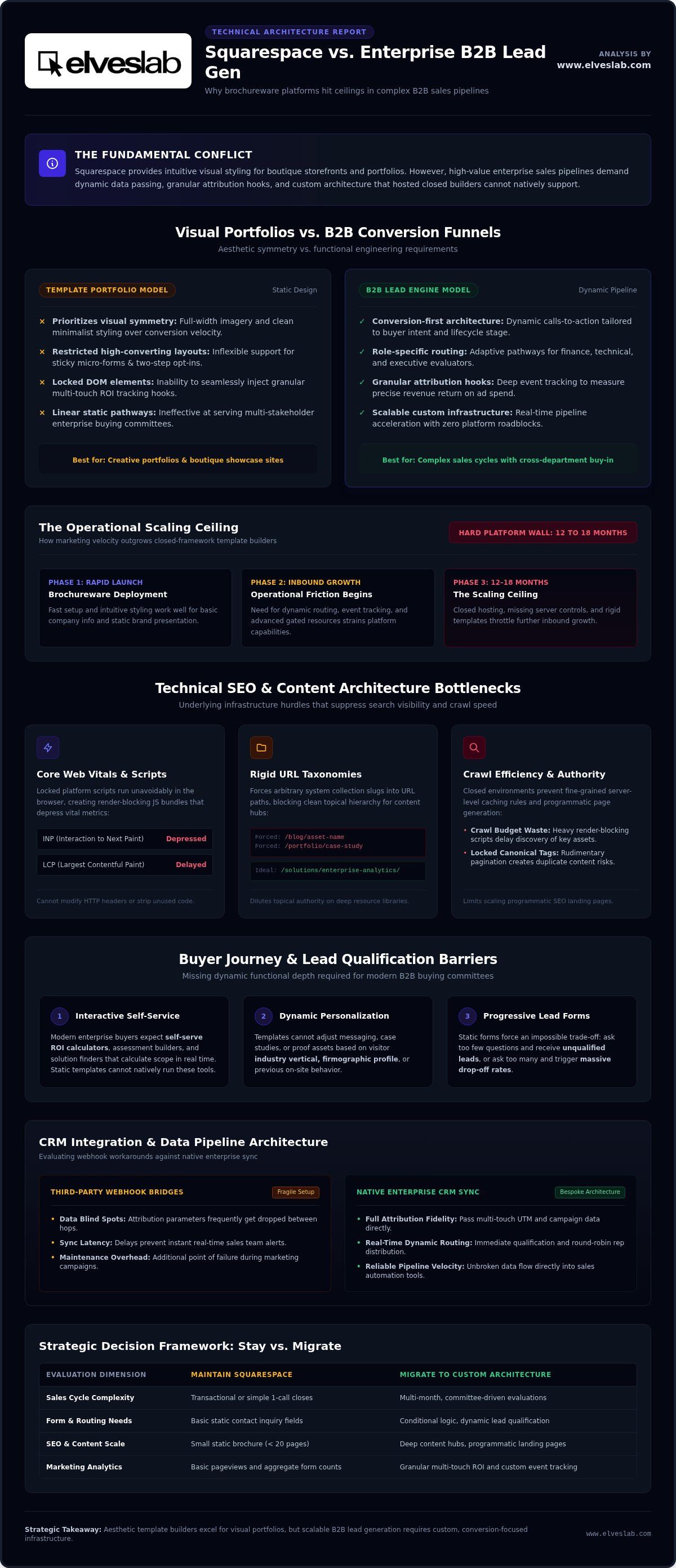
B2B client acquisition isn't a simple transactional interaction. While consumer brands thrive on quick checkouts, enterprise sales cycles span months, require cross-department buy-in, and rely heavily on pipeline automation. As a hosted site builder, Squarespace provides intuitive styling tools for boutique storefronts and creative portfolios. However, scaling firms quickly discover deep architectural barriers when deploying sophisticated inbound funnels. Understanding the core squarespace limitations for b2b lead generation websites is critical before sunk design costs lock you into an inflexible stack.
Closed-ecosystem website builders manage your hosting, styling, and markup within a locked framework. This model works well for straightforward static brochures. Yet, as lead velocity increases, your marketing engine requires dynamic behavior: custom event tracking, intelligent data passing, and real-time lead routing. Without server-level controls or programmatic page generation, fast-growing businesses hit an operational ceiling within twelve to eighteen months of scaling marketing operations.
The Fundamental Divide: Visual Portfolios vs B2B Conversion Funnels
Visual appeal doesn't equal pipeline capture. Creative portfolios prioritize full-width imagery, clean typography, and minimalist layouts. In contrast, B2B conversion funnels require precise landing page architecture, granular attribution scripts, and dynamic calls to action. Squarespace templates emphasize aesthetic symmetry over functional flexibility, restricting high-performing layouts like sticky micro-forms, two-step opt-ins, and complex social proof arrays. Without deep access to inject custom tracking hooks seamlessly into DOM elements, measuring true multi-touch ROI becomes an uphill battle.
Template Constraints on Complex Buyer Journeys
Modern enterprise deals involve multiple decision-makers across finance, technical evaluation, and executive leadership. Serving this buying committee requires adaptive, role-specific content pathways that static builders simply can't provide:
- Interactive tools: Buyers expect self-serve ROI calculators, assessment builders, and interactive solution finders that calculate project scope on the fly.
- Dynamic personalization: Templates cannot natively adjust messaging or assets based on visitor industry, firmographic profile, or past visit behavior.
- Progressive lead qualification: Static forms force you to choose between asking too few questions to qualify a lead or creating friction that causes high drop-offs.
When enterprise evaluators encounter rigid pages that offer no dynamic depth, they leave without engaging. These structural hurdles explain why addressing squarespace limitations for b2b lead generation websites requires looking beyond template styling and focusing on tailored, conversion-focused infrastructure.
Technical SEO and Content Architecture Bottlenecks
Organic search remains the backbone of sustainable B2B pipeline growth. When potential enterprise clients research complex solutions, your technical infrastructure determines whether your content gets discovered or stays buried. While closed builders provide basic on-page fields, Forbes Advisor's in-depth Squarespace review points out the platform's balance of simplicity and trade-offs. For serious growth teams, those trade-offs manifest as deep squarespace limitations for b2b lead generation websites, especially around indexation, crawl efficiency, and Core Web Vitals.
Closed hosting environments prevent you from tweaking server caching rules, adjusting HTTP response headers, or stripping unused JavaScript bundles. Squarespace pages carry locked platform scripts that burden browser execution, often depressing Interaction to Next Paint (INP) and Largest Contentful Paint (LCP) scores. When crawl bots encounter these render-blocking scripts across hundreds of resource pages, crawl budgets get wasted, delaying the discovery of critical sales assets.
Rigid URL Structures and Taxonomies for Gated Assets
B2B content strategies rely on organized content hubs, whitepapers, and customer case studies. Squarespace forces rigid collection slugs into every collection path, such as /blog/ or /portfolio/. This platform restriction prevents you from establishing clean, topical subfolder hierarchies like /solutions/enterprise-analytics/. Additionally, locked canonical tags and rudimentary pagination controls create duplicate content risks, diluting your link authority across deep resource archives.
Programmatic SEO and Schema Markup Constraints
Scaling organic pipeline often requires generating hundreds of targeted landing pages tailored by vertical, industry, or technical integration. Template platforms lack the database capabilities needed to drive programmatic generation from structured data models:
- Automated JSON-LD gaps: You cannot dynamically inject nested schemas like
TechArticle, Organization, or custom FAQ entities across thousands of pages without manual code blocks on every page.
- Taxonomy limits: Rigid category rules prevent multi-faceted filtering for complex enterprise case study libraries.
- Database isolation: Content cannot be queried dynamically into dynamic comparison tables or contextual industry hubs.
To overcome these bottlenecks, enterprise teams turn to modern search engine optimization strategies built on open data structures. If you find your organic pipeline plateauing behind rigid template rules, partnering with experienced specialists for custom CMS engineering will establish the clean, high-performance foundation your inbound strategy actually demands.
B2B lead generation relies on precise lead qualification and immediate routing. When an enterprise prospect lands on your site, every interaction must capture context, validate contact credentials, and feed accurate records into your sales machinery. Native form elements on closed platforms work well for simple inquiries, but they break down under the weight of enterprise requirements. These capture bottlenecks represent some of the most frustrating Squarespace limitations for B2B lead generation websites, turning promising pipeline traffic into untracked, generic contact logs.
Marketing teams often patch these gaps using custom scripts and iFrames. Unfortunately, nesting external forms inside rigid templates introduces layout shifts, breaks accessibility guidelines, and causes tracking pixels to drop critical touchpoints before submission.
Static Forms vs Conditional Routing and Progressive Profiling
High-converting B2B landing pages adjust to user input in real time. If a prospect selects an enterprise team size or a specific use case, dynamic forms reveal tailored qualifying questions or routing fields. Squarespace form blocks remain strictly static, forcing you to use long, intimidating forms or overly simple ones that flood your pipeline with unqualified submissions. Lacking native conditional logic, you miss the chance to trigger progressive profiling, an essential tactic where returning visitors see new, deeper discovery questions rather than repeat fields.
Native Middleware Dependencies and API Fragility
Squarespace lacks native, deep bi-directional synchronization with platforms like HubSpot, Salesforce, or Marketo. Instead, transferring lead data requires middleware webhooks, Zapier zaps, or third-party sync layers. These dependencies introduce real vulnerabilities:
- Latency and silent errors: Webhook outages delay routing. Industry data shows practices that email inquiries within 2 hours see 40% higher conversion rates, yet broken automations leave leads sitting unassigned.
- Security risks: Chaining intermediary connectors across external servers expands your compliance footprint under frameworks like GDPR.
- Fragile maintenance: An updated field label or API change in your CRM can silently disconnect your lead stream without triggering immediate warnings.
Closed Ecosystem vs Enterprise Marketing Automation Stacks
Revenue teams need to trace multi-touch customer journeys from first ad click to closed contract. Industry analyses from agencies like swell.is highlight how third-party plugins struggle to replace enterprise-grade architectures. In closed setups, cookie restrictions block server-side tagging, obscuring which ad campaigns drove pipeline revenue. You lose account-level intelligence, rendering Account-Based Marketing (ABM) tracking virtually impossible.
Confronting these Squarespace limitations for B2B lead generation websites forces a strategic decision: keep managing brittle Zapier integrations, or build a resilient digital foundation engineered for pipeline growth.
When to Stay on Squarespace vs. Migrate to Custom Web
Squarespace serves an essential purpose in early business validation. Solopreneurs, boutique consultants, and early-stage firms benefit from all-in-one hosting, pre-built templates, and rapid launch times. If your sales process relies on referral introductions, simple contact messages, or manual follow-ups, staying on a hosted builder keeps overhead low. The friction begins when lead velocity accelerates. Once marketing spend scales, the underlying squarespace limitations for b2b lead generation websites shift from minor inconveniences into direct drains on commercial growth.
Deciding whether to remain on a template builder or migrate to a tailored digital asset requires assessing pipeline economics rather than surface aesthetics. When your customer acquisition model depends on dynamic landing pages, deep attribution, and integrated sales workflows, closed platforms hit a hard ceiling.
Self-Audit Checklist: Assessing Your Pipeline Complexity
To determine if your current tech stack still serves your pipeline goals, run through this practical diagnostic:
- Sales velocity: Do your deals require automated qualification, role-based scheduling, and multi-tier account governance?
- Lead volume and routing: Are your team members spending hours manually fixing broken webhook relays, re-keying lead details, or sorting unqualified submissions?
- Asset gating: Does your marketing team struggle to build restricted client portals, tiered resource libraries, or dynamic whitepaper funnels?
- Integration overhead: Are you paying for multiple third-party subscription add-ons just to perform basic lead capture tasks that custom platforms handle natively?
Calculating the Opportunity Cost of Stalled Lead Velocity
Every point of friction in your funnel carries a quantifiable cost. If sluggish scripts degrade mobile performance or clunky form elements drive prospects away, paid acquisition budgets lose efficiency. Research reveals that firms using visible, intuitive booking workflows generate 35% to 50% more consultations. Meanwhile, automated nurture sequences convert 20% to 30% of cold inquiries into paying clients. If your platform prevents you from deploying frictionless scheduling blocks or multi-variant A/B testing on core landing pages, those pipeline conversions simply evaporate.
Sticking with off-the-shelf templates past their useful life quietly erodes customer acquisition ROI. Upgrading your web infrastructure to bespoke custom web design removes artificial constraints, giving your sales pipeline the performance and technical agility it needs. When you are ready to turn your online presence into a high-converting digital engine, partner with our engineering team at Elves Lab to build a scalable, bespoke platform tailored to your growth goals.
Transitioning to Bespoke Architecture for Scalable Lead Generation
Stepping away from template constraints isn't just a visual refresh. It's a strategic evolution in how your digital infrastructure creates revenue. Overcoming squarespace limitations for b2b lead generation websites requires moving toward purpose-built architectures engineered specifically for your commercial pipeline. Bespoke development eliminates third-party plugin bloat, gives your developers complete command over the DOM, and establishes dedicated hosting environments optimized for speed.
Clean codebase execution ensures your pages render without heavy, unused JavaScript libraries. Marketing teams gain real operational autonomy. Instead of wrestling with rigid design boxes, your team works within a tailored CMS configured around your specific publishing workflows, approval tiers, and content governance needs.
Designing Scalable Digital Infrastructure for B2B Demand Gen
High-performing B2B platforms rely on structured data models rather than locked layout presets. Flexible relational database schemas allow you to dynamically cross-reference customer case studies by industry, deployment size, and software tier without manual page duplication. When your demand-generation strategy calls for gated portals, dynamic solution finders, or self-serve ROI calculators, deploying advanced web application development delivers interactive utility that static site builders cannot replicate.
Future-Proofing Growth with Custom CMS and Systems Integration
Custom software engineering replaces fragile middleware relays with direct, server-to-server connectivity. Consider the technical advantages of dedicated pipeline integrations:
- Direct API pipelines: Send captured lead events straight to Salesforce, HubSpot, or custom databases using secure REST or GraphQL endpoints with zero third-party latency.
- Granular event capture: Track deep user engagement, video completions, and scroll depth on your own infrastructure to feed rich behavioral data into your CRM.
- Custom editorial workflows: Build bespoke admin panels that allow non-technical marketers to launch conversion-focused landing pages quickly while preserving global brand governance.
Resolving persistent squarespace limitations for b2b lead generation websites through bespoke web engineering transforms your online presence from a static digital brochure into an automated, scalable revenue engine built for long-term growth.
A clean aesthetic should never come at the expense of your sales pipeline. While template platforms excel at visual presentation, high-growth firms inevitably outgrow static forms, fragile webhook bridges, and rigid page taxonomies. Overcoming these squarespace limitations for b2b lead generation websites requires a deliberate shift toward an open, high-converting digital foundation engineered around your buyers' complex journey.
With over two decades of bespoke web design and custom software engineering expertise, our team delivers comprehensive technical solutions combining custom CMS development, high-speed web hosting, and strategic SEO. Stop losing high-intent prospects to template bottlenecks. Partner with Elves Lab for custom web design and scalable digital growth, and turn your website into an automated, high-performing revenue asset built to scale smoothly for years to come.
Frequently Asked Questions
Can Squarespace effectively support an enterprise B2B sales pipeline?
No, Squarespace cannot reliably manage complex enterprise sales funnels. While it works well for simple brochure sites and transactional inquiries, enterprise deals require progressive profiling, multi-step validation, and conditional routing. Navigating squarespace limitations for b2b lead generation websites becomes painful when attempting to automate buyer journeys across multi-member evaluation committees.
How do Squarespace limitations impact technical SEO for B2B websites?
Squarespace restricts technical SEO through rigid subfolder prefixes, automated canonical tags, and locked server environments. Research indicates an average SEO audit score of just 40.5/100 across Squarespace websites, reflecting these deep architectural constraints. You cannot customize server caching, build nested topical subdirectories, or inject automated JSON-LD schemas across large resource libraries.
Is it possible to connect enterprise CRMs like Salesforce or HubSpot to Squarespace?
You can connect enterprise CRMs, but only through intermediary tools like Zapier or brittle embedded forms. Squarespace has no native, deep bi-directional CRM integration. Chaining third-party webhooks creates latency, breaks form tracking scripts, and increases the risk of silent sync failures that drop high-value leads before your sales team notices.
What happens when a B2B website experiences high traffic spikes on template platforms?
Traffic spikes from aggressive ad campaigns or industry press can slow down hosted template pages significantly. Because you share managed server resources without root access, you cannot deploy edge caching rules, autoscale server instances, or optimize database queries. Sluggish responses directly inflate bounce rates during high-visibility growth moments.
How much does template script bloat affect Core Web Vitals and mobile conversion rates?
Template script overhead significantly drags down Core Web Vitals, especially Largest Contentful Paint and Interaction to Next Paint. Locked JavaScript bundles and render-blocking styles load across every page regardless of whether they are used. Slower mobile speeds frustrate evaluators and immediately decrease conversion efficiency on paid acquisition traffic.
Why do marketing teams struggle with gated content and asset libraries on Squarespace?
Squarespace lacks flexible database collections and granular access controls for sophisticated content hubs. Managing hundreds of gated whitepapers, ungated case studies, and industry briefs requires tedious manual page assembly. Marketing teams run up against strict collection limits instead of querying dynamic content assets from structured relational databases.
When should a growing business migrate from Squarespace to a custom CMS website?
Migrate as soon as platform workarounds, manual data entry, and slow performance begin stalling your pipeline velocity. When managing squarespace limitations for b2b lead generation websites costs more in lost opportunities and plugin subscriptions than a custom build, upgrading to bespoke web architecture delivers the speed, security, and integration depth needed to scale.
Disclaimer
AI-Generated Content Disclaimer
The articles, blog posts, and informational content published on this website may be generated or assisted by artificial intelligence (AI) tools for search engine optimisation (SEO), content discovery, and informational purposes.
While reasonable efforts are made to ensure the content is relevant and useful, the information provided may not always be accurate, complete, current, or applicable to your specific circumstances. The views, opinions, statements, recommendations, or interpretations expressed in these articles are generated based on publicly available information and do not necessarily reflect the views, opinions, positions, policies, or professional advice of our company, its management, employees, partners, or affiliates.
The content should not be construed as legal, financial, medical, technical, professional, or other specialised advice. Readers are encouraged to independently verify any information and seek professional consultation where appropriate before making decisions based on the content provided.
Our company shall not be held liable for any loss, damage, claim, or consequence arising directly or indirectly from the use of, reliance upon, or interpretation of any AI-generated content published on this website.
By accessing and using this website, you acknowledge and accept that certain content may be generated or assisted by AI technologies and is provided on an "as is" basis for informational and SEO purposes only.