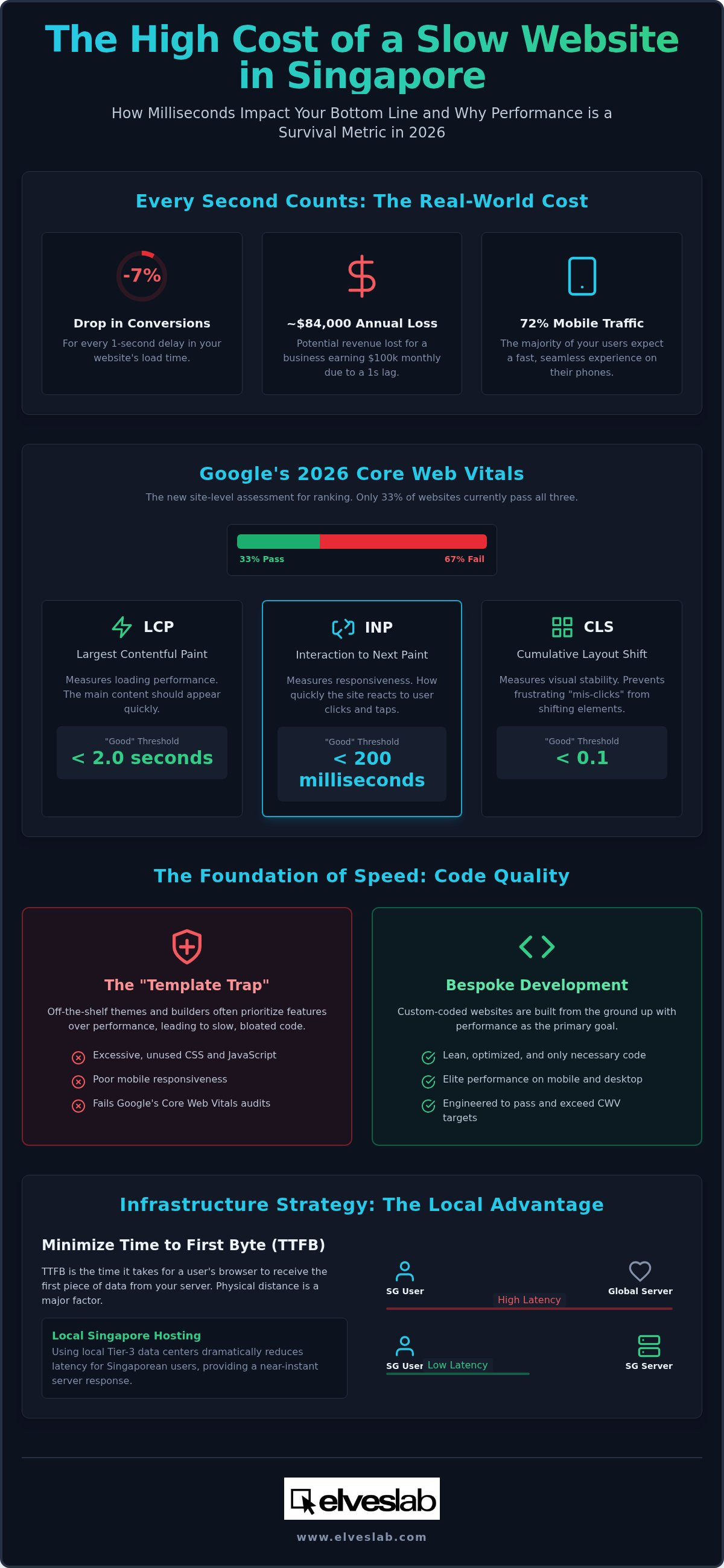
A single second of lag on your website can slash your conversions by 7%, potentially costing a business earning $100,000 monthly over $84,000 in annual revenue. In a market where 72% of traffic comes from mobile devices, a slow site isn't just an inconvenience; it's a silent profit killer. You've likely felt the sting of losing customers to faster competitors or struggling with bloated templates that won't pass Google's latest audits. Achieving elite website performance optimization Singapore requires moving beyond generic fixes to embrace technical precision tailored for our local 5G environment.
We understand that the technical side of speed can feel overwhelming, especially with Google's 2026 site-level assessments. This guide promises to help you master the strategic pillars needed to dominate search rankings and maximize conversion rates. You'll learn how to hit the new 2.0-second LCP threshold and maintain an Interaction to Next Paint (INP) under 200ms. We'll explore the move toward custom code, the impact of local Singapore hosting, and how to build a digital presence that's as fast as the users it serves.
Key Takeaways
- Discover why speed is a survival metric in a market with 98.4% internet penetration and how slow load times directly bleed your annual revenue.
- Master the 2026 Core Web Vitals standards, focusing on the new 2.0-second LCP threshold and the critical INP responsiveness score.
- Learn why bespoke development beats the "template trap" to provide the lean foundation required for elite website performance optimization Singapore.
- Understand the infrastructure edge of using local Singapore hosting and Tier-3 data centers to minimize your site's Time to First Byte.
- Find out how professional performance audits identify hidden technical bottlenecks that prevent your business from reaching its full conversion potential.
True Web performance optimization (WPO) isn't just about a loading spinner that disappears quickly. In 2026, it's the technical synergy between lightning-fast loading, immediate input responsiveness, and total visual stability. For local businesses, website performance optimization Singapore has shifted from a "nice-to-have" feature to a core survival metric. With Singapore’s internet penetration reaching 98.4%, your website is often the first, and sometimes only, point of contact with your audience. If that contact is sluggish, the relationship ends before it begins.
The stakes have never been higher because our digital infrastructure is world-class. Singaporeans navigating on 5G networks expect instantaneous interactions as the baseline. When your site takes three seconds to load while a competitor’s takes one, you aren't just losing a click. You're signaling that your brand is behind the times. Sub-par speed acts as a silent business killer, eroding trust and driving local traffic toward more agile competitors who prioritize their technical foundation.
The Psychology of Speed for the Singaporean Consumer
We live in a culture of instant gratification. In Singapore's fast-paced digital economy, user frustration scales exponentially with every millisecond of delay. Research shows that a mere one-second lag can lead to a 7% drop in conversions. That’s not just a statistic; it's a direct hit to your bottom line. For e-commerce platforms, this friction is the primary driver of cart abandonment. Local shoppers won't wait for a bloated template to organize itself on their screens. They'll simply bounce. A fast site creates a "halo effect" where users perceive your entire business as more professional, reliable, and efficient.
Search Visibility and Google’s Performance Mandate
Google has made it clear that speed is no longer an optional bonus. It serves as a critical tie-breaker in the fiercely competitive Singaporean search landscape. Through the Page Experience signal, Google rewards sites that provide a seamless journey from the first click to the final interaction. If two businesses offer similar content, the one with the superior technical score will always claim the higher rank. In 2026, technical performance is the non-negotiable foundation of modern SEO Singapore. Without it, even the most creative content will struggle to surface in AI-driven search results.
Google’s March 2026 update fundamentally changed how we approach website performance optimization Singapore. It shifted the focus from individual page metrics to a comprehensive, site-level assessment. This means every corner of your domain must perform at an elite level to maintain search visibility. Currently, only 33% of websites pass all three Core Web Vitals. This performance gap is your greatest opportunity to outrank competitors who rely on outdated benchmarks. These metrics aren't just technical hurdles; they're the digital vital signs of your business health.
The "Trinity" of performance consists of three pillars. Largest Contentful Paint (LCP) measures how quickly the main content loads, with the 2026 "Good" threshold now tightened to under 2.0 seconds. Cumulative Layout Shift (CLS) quantifies visual stability. A score of 0.1 or less ensures that elements don't jump around, preventing the "mis-clicks" that frustrate mobile users. Finally, Interaction to Next Paint (INP) measures the time between a user’s action and the visual update on the screen. To pass, your site must react in under 200ms. Together, these form the gold standard for modern user experience.
Measuring What Matters: Beyond Simple Load Times
Differentiating between "Time to First Byte" (TTFB) and "Time to Interactive" (TTI) is essential for a deep technical audit. TTFB tells you how fast your server responds, while TTI marks the moment a user can actually use your site. While lab tests are useful for development, they often miss the reality of local mobile users on varying signal strengths. We rely on the Chrome User Experience Report (CrUX) for real-world Singaporean user data. Understanding the Basics of Web Performance Testing helps you move beyond synthetic scores to see what your customers actually experience on their devices.
Interaction to Next Paint (INP): The New Gold Standard
INP has officially replaced FID (First Input Delay) as the primary responsiveness metric. This change is particularly significant for complex web application development Singapore, where interactive elements like filters, sliders, and dynamic forms are common. A high INP score usually points to a cluttered main thread. To fix this, you must reduce JavaScript execution time and defer non-essential scripts. Third-party additions like chatbots and tracking pixels are often the hidden culprits behind sluggish responsiveness. If your site feels heavy or unresponsive, partnering with a technical expert to trim the bloat can instantly boost your INP scores and user satisfaction.
Custom Code vs. Template Bloat: The Foundation of Speed
Many Singaporean businesses fall into the "Template Trap" when launching a new site. They buy a $50 theme that looks great in a demo but carries a heavy secret. These themes are built to accommodate every possible feature, meaning they ship with up to 90% unused code. This dead weight is the primary obstacle to achieving elite website performance optimization Singapore. When you use a generic page builder, every layout choice adds layers of CSS and JavaScript that the browser has to parse. This creates technical debt that "optimization" plugins simply can't fix.
A custom web design Singapore strategy avoids this by building only what you need. We use techniques like "Code Splitting", which breaks your site's code into small, manageable chunks. Instead of loading the entire site's logic at once, the browser only fetches the code required for the specific page being viewed. When combined with "Lazy Loading" for non-critical elements, your site feels instantaneous. For those wanting to dive deeper into these mechanics, Google offers a comprehensive web performance course that details how these architectural choices impact long-term SEO.
Why Bespoke CMS Architectures Outperform Generic Platforms
Generic platforms like WordPress rely on a one-size-fits-all database structure. As you add more plugins to gain functionality, the database bloat grows, slowing down every query. Bespoke CMS architectures are different. They're designed with database efficiency as a priority, ensuring that data retrieval is lean and direct. By choosing custom software development, you eliminate the need for third-party plugins that often introduce security vulnerabilities and performance bottlenecks. It's a cleaner, faster, and more secure way to manage your digital presence.
Asset Optimization: Images, Video, and Fonts
In 2026, raw speed depends on how you handle heavy assets. We've moved past basic JPEGs to next-gen formats like WebP and AVIF, which offer superior compression without losing visual quality. This is a cornerstone of website performance optimization Singapore. This is especially vital when integrating AI video generation Singapore content. To keep mobile speeds high, we serve these videos in optimized containers and use adaptive bitrate streaming. Even fonts matter; self-hosting your brand's typography instead of relying on external Google Fonts requests can shave precious milliseconds off your LCP score by reducing DNS lookups.
Infrastructure Strategy: Local Singapore Hosting and CDNs
Your code can be perfect, but if your server is halfway across the globe, your site will still crawl. Server proximity is the most influential factor in reducing Time to First Byte (TTFB). For website performance optimization Singapore, hosting your data within a Tier-3 data center located in the city-state isn't optional. It's a strategic necessity. While global Content Delivery Networks (CDNs) are excellent for serving static assets, the "last mile" latency for dynamic requests can only be solved by local physical infrastructure. This ensures that the initial connection happens in milliseconds, not seconds.
By 2026, the adoption of HTTP/3 and the QUIC protocol has become the standard for high-speed delivery. Unlike older protocols, QUIC reduces the number of round trips required to establish a secure connection. This is a game changer for Singapore’s 9.79 million mobile connections, where users often switch between 5G and public Wi-Fi. It ensures that even on fluctuating networks, your site remains snappy and responsive. Combining local hosting with a properly configured CDN creates a redundant, lightning-fast environment that handles traffic spikes with ease.
Selecting Reliable Web Hosting in Singapore
Don't be fooled by the myth of "unlimited" shared hosting. Shared resources mean your site's speed is at the mercy of every other site on that server. For enterprise-level performance, look for hosts offering NVMe storage and robust server-side caching. We integrate these high-performance hosting solutions directly into our e-commerce development Singapore projects. This ensures that your storefront doesn't just look good but has the raw horsepower to handle thousands of concurrent shoppers without a hiccup. SSD storage is the baseline; NVMe is the 2026 requirement for speed.
Advanced Infrastructure: Edge Computing and Prefetching
Edge SEO allows us to inject performance optimizations at the CDN level before the browser even starts loading the page. By using "DNS Prefetching" and "Preconnect" directives, we tell the browser to resolve domain names and establish connections to third-party scripts in advance. For complex web applications, server-side rendering (SSR) provides the ultimate speed advantage by delivering fully formed HTML to the user’s device instead of making the browser do the heavy lifting. If you want to benchmark your current setup against these 2026 standards, consult our infrastructure specialists to see where you can shave off those final, critical milliseconds.
Elves Lab approaches every project with a "Performance-First" philosophy. We don't believe speed is an afterthought or something you "fix" with a plugin after the site is launched. It's baked into the very first line of code we write. With over 24 years of experience in the local market, we've seen how "template bloat" can slowly strangle a business's growth and search visibility. Our role is to act as your technical partner, helping you transition from heavy, generic themes to lean, bespoke architectures that thrive in the 2026 digital environment. We take the technical burden off your shoulders so you can focus on running your business.
When we conduct a deep-dive audit, we look far beyond the surface-level scores. We identify hidden bottlenecks in your database queries, inefficient server-side scripts, and third-party dependencies that drain your resources. Elite website performance optimization Singapore isn't a static achievement. It's a continuous process of refinement and technical precision. By choosing a custom approach over a template, you're not just getting a faster site today; you're building a foundation that's easy to scale and maintain as your business evolves and web standards continue to tighten.
Our 2026 Optimization Roadmap for Singapore SMEs
Success starts with a clear, methodical plan. We guide our partners through a structured three-step process to ensure every millisecond is accounted for:
- Step 1: Technical Audit and Core Web Vitals Baseline. We use real-world data to measure your current performance against 2026 standards, identifying exactly where your site is losing potential customers.
- Step 2: Backend Refactoring and Database Optimization. We clean up the "engine room." This involves optimizing how your site communicates with its database and removing the legacy code that slows down server response times.
- Step 3: Frontend Asset Compression and Modern Delivery Protocols. We implement the next-gen formats and protocols like HTTP/3, ensuring your images, videos, and scripts reach users instantly on any device or network.
Scaling with Confidence: Support and Maintenance
Performance isn't a one-time fix. As you add new products, blog posts, or marketing tracking scripts, your site's speed can naturally degrade over time. That's why continuous monitoring is vital in 2026. Our integrated SEO and development teams work in tandem to ensure that every update adheres to our strict speed standards. We don't just hand over a fast site and disappear. We provide the ongoing support needed to keep your website performance optimization Singapore at the top of the search rankings. Ready to see what your site is truly capable of? Contact Elves Lab for a performance audit today and let’s start building your high-speed future together.
Turn Speed into Your Competitive Edge
The digital standards of 2026 leave no room for sluggish performance. As we've explored, mastering website performance optimization Singapore requires a shift from generic templates to precision-engineered custom code. By prioritizing the 2.0-second LCP threshold and leveraging local infrastructure, you aren't just satisfying an algorithm; you're building trust with every visitor. Speed is the foundation of your digital growth, and the gap between leaders and laggards is only widening.
With 24+ years of bespoke development expertise, Elves Lab is here to help you navigate these technical complexities. Our proven track record of passing Core Web Vitals and our Singapore-based Tier-3 data center hosting provide the infrastructure your brand needs to thrive. Don't let technical debt hold your business back from reaching its full conversion potential. Take the first step toward a faster, more resilient site by choosing experts who treat performance as a priority from day one. Get a Professional Performance Audit from Elves Lab today. We're excited to help you transform your website into a high-performance engine that delivers results.
Frequently Asked Questions
What is a good website loading speed for a Singapore business in 2026?
A good loading speed in 2026 is a Largest Contentful Paint (LCP) of under 2.0 seconds. Singaporean users on high-speed 5G networks expect instantaneous interactions, so hitting this mark is essential for retaining traffic. While a sub-3 second total load time used to be the benchmark, the bar has moved. Aiming for sub-2 seconds ensures you meet Google’s "Good" threshold and provide the seamless experience local consumers now demand.
How does website speed affect my Google ranking in Singapore?
Website speed acts as a critical tie-breaker in competitive local search results. Google uses Core Web Vitals as part of its Page Experience signal to determine which sites offer a better user journey. If your site is slow, you'll likely see lower visibility in both traditional search and newer AI Overviews. Effective website performance optimization Singapore helps you secure those top spots by proving your technical reliability to search algorithms.
Can I optimize my current website without a full redesign?
You can often achieve significant gains through technical refactoring without a complete visual overhaul. This involves optimizing your database queries, compressing frontend assets, and implementing better caching strategies. However, if your current site is built on a heavily bloated template, there’s a limit to what "patching" can do. A deep audit will reveal whether your foundation is salvageable or if a move toward a leaner, custom-coded architecture is necessary for long-term growth.
What is the difference between local Singapore hosting and a global CDN?
Local Singapore hosting places your actual server in a physical data center within the country, which is the most effective way to reduce Time to First Byte (TTFB). A global CDN stores copies of your static assets on servers around the world. While a CDN is great for international audiences, local hosting ensures that dynamic requests from Singaporean users are processed with the lowest possible latency. Combining both offers the ultimate speed advantage.
How do Core Web Vitals (LCP, CLS, INP) impact my conversion rates?
These metrics directly measure user friction. A poor LCP means users get bored and leave, while a high CLS leads to accidental clicks that frustrate shoppers. Interaction to Next Paint (INP) ensures that when a user clicks "Add to Cart," the site responds immediately. Research indicates that a single second of delay can reduce conversions by 7%, so passing these vitals is a direct investment in your company's monthly revenue and brand reputation.
Why is my website slower on mobile devices compared to desktop?
Mobile devices generally have less processing power than desktops, making them slower at parsing complex JavaScript. Additionally, even on 5G, mobile networks can experience higher latency than fixed fiber lines. Since 72% of Singapore’s web traffic is mobile, you must prioritize a mobile-first optimization strategy. This means delivering lighter assets and reducing the "main thread" work that often chokes mobile browsers during the initial page load. Focus on lean code to close the gap.
Is Interaction to Next Paint (INP) really that important for SEO?
INP is absolutely vital because it replaced First Input Delay as a primary ranking signal in 2026. It measures the responsiveness of your entire page, not just the first interaction. Google uses this to ensure that sites aren't just fast to show content but are also smooth to use. If your site feels "janky" or unresponsive during navigation, your SEO rankings will suffer as Google prioritizes more reactive competitors in our local market.
How often should I conduct a website performance audit?
You should conduct a comprehensive performance audit at least once every quarter. Digital environments change quickly, and new content or third-party scripts can easily introduce speed bottlenecks. Regular checks ensure that your website performance optimization Singapore remains effective as you scale. It’s also wise to run an audit after any major site update or software addition to catch issues before they impact your search rankings or conversion rates. Consistent monitoring prevents performance decay.
Disclaimer
AI-Generated Content Disclaimer
The articles, blog posts, and informational content published on this website may be generated or assisted by artificial intelligence (AI) tools for search engine optimisation (SEO), content discovery, and informational purposes.
While reasonable efforts are made to ensure the content is relevant and useful, the information provided may not always be accurate, complete, current, or applicable to your specific circumstances. The views, opinions, statements, recommendations, or interpretations expressed in these articles are generated based on publicly available information and do not necessarily reflect the views, opinions, positions, policies, or professional advice of our company, its management, employees, partners, or affiliates.
The content should not be construed as legal, financial, medical, technical, professional, or other specialised advice. Readers are encouraged to independently verify any information and seek professional consultation where appropriate before making decisions based on the content provided.
Our company shall not be held liable for any loss, damage, claim, or consequence arising directly or indirectly from the use of, reliance upon, or interpretation of any AI-generated content published on this website.
By accessing and using this website, you acknowledge and accept that certain content may be generated or assisted by AI technologies and is provided on an "as is" basis for informational and SEO purposes only.