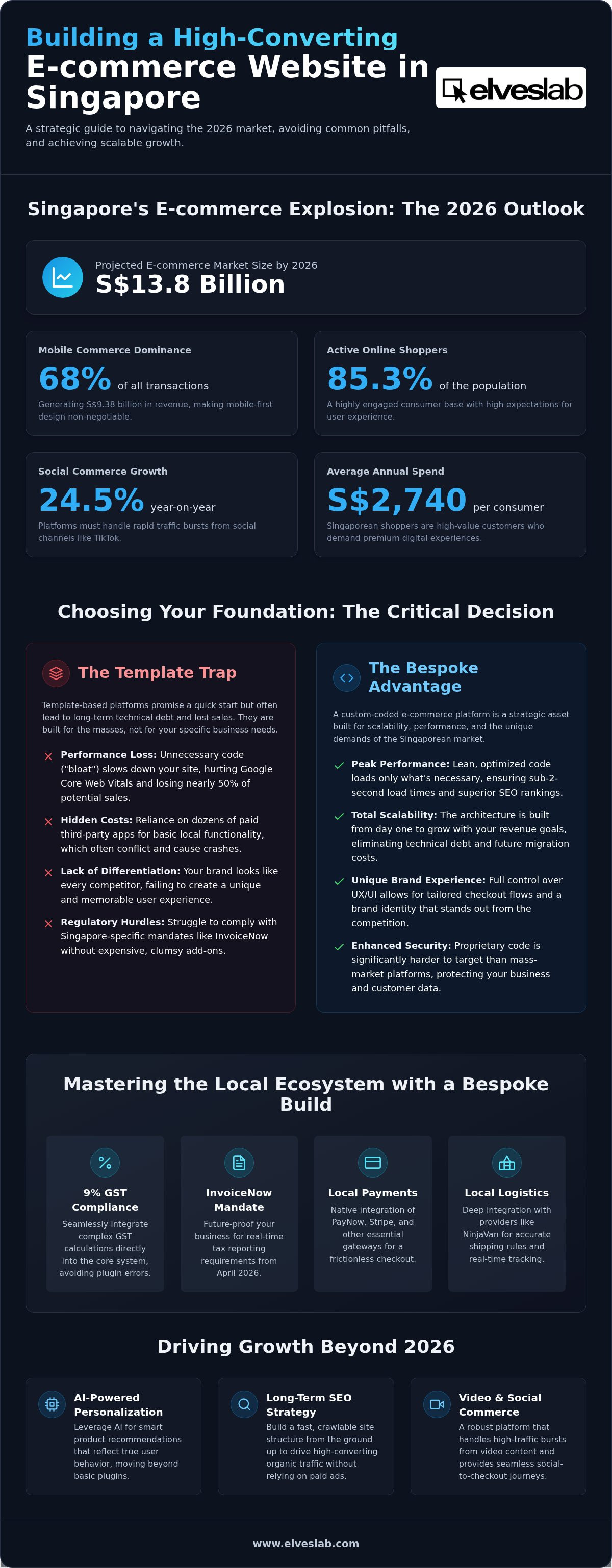
By 2026, Singapore's e-commerce market is projected to reach a staggering S$13.8 billion, yet many businesses still lose nearly half their potential sales to slow, template-based storefronts. You've likely felt the frustration of rigid designs that won't let you grow or the headache of trying to decode the latest government grant requirements. Building a truly competitive e-commerce website Singapore requires more than just a basic shop. It demands a bespoke architecture that handles the 9% GST rate, the InvoiceNow mandate, and the specific needs of a mobile-first audience.
We know your digital growth shouldn't be limited by your software. This strategic guide offers a comprehensive roadmap to building a scalable, high-converting platform that eliminates technical debt. We'll show you how to master local market complexities, from securing EDGE Grant funding to integrating PayNow and local logistics seamlessly. You'll learn how to maximize your ROI through organic search visibility and stay ahead of the curve with 2026 trends like AI-powered personalization and video content. It's time to stop fighting your platform and start growing your brand.
Key Takeaways
- Learn why choosing a bespoke e-commerce website Singapore is the only way to avoid technical debt and ensure your platform scales with your 2026 revenue goals.
- Discover how to navigate the transition from PSG to the consolidated EDGE Grant framework to secure maximum funding for your digital transformation.
- Master the integration of Singapore's essential payment and logistics networks, including PayNow, Stripe, and NinjaVan, for a seamless customer journey.
- Explore how to leverage AI video generation and long-term SEO strategies to drive high-converting traffic without relying solely on expensive paid ads.
- Understand the "Built from Scratch" philosophy that has helped Singaporean businesses thrive for over 25 years by prioritizing custom code over rigid templates.
The E-commerce Landscape in Singapore (2026)
The modern definition of a successful e-commerce website Singapore has evolved far beyond a simple digital storefront. Today, it's a high-performance engine that serves as the primary touchpoint for a population where 85.3% are active online shoppers. While the basic definition of e-commerce remains the buying and selling of goods online, the Singaporean context in 2026 demands a sophisticated blend of speed, localized tax compliance, and extreme mobile optimization. Local businesses aren't just competing with each other; they're competing with global giants for the attention of consumers who spend an average of S$2,740 annually online.
Consumer Behavior Trends in 2026
The local retail sector is seeing a massive rise in 'Phygital' experiences. This means your e-commerce website Singapore must bridge the gap between digital browsing and physical fulfillment. Whether it's real-time inventory tracking for click-and-collect or in-store QR codes that trigger personalized online discounts, the boundary is gone. AI-driven personalization has also moved from a luxury to a necessity. Shoppers expect product recommendations that actually reflect their habits. Additionally, sustainability has become a core brand requirement. Singaporeans now look for ethical shipping options and eco-friendly packaging at the checkout stage, often choosing brands that align with these values.
Why 'Off-the-Shelf' is No Longer Enough
Generic global templates are struggling to keep up with Singapore's unique regulatory environment. From April 1, 2026, the InvoiceNow mandate requires real-time tax reporting for new GST registrants. Most "one-size-fits-all" themes can't handle this without expensive, messy third-party apps. These SaaS platforms often come with hidden costs; subscription fees for essential plugins can quickly eat into your margins. Rigid templates also create a "sea of sameness" where your brand looks exactly like your competitor's. Bespoke e-commerce development represents a strategic business asset that empowers Singaporean SMEs to own their technology stack, eliminate recurring subscription bloat, and deliver a unique brand experience that templates simply cannot replicate.
Custom vs. Template: Choosing Your Foundation
Choosing the right foundation for your e-commerce website Singapore is the most critical decision you'll make for your digital future. Many startups gravitate toward template-based SaaS platforms because they promise a quick launch and low upfront costs. However, as the eCommerce market in Singapore matures, these rigid structures often become a bottleneck. Templates are built for the masses; they include thousands of lines of unnecessary code to accommodate every possible user. This leads to "bloat," which directly impacts your Google Core Web Vitals, specifically your Largest Contentful Paint (LCP). Custom-coded sites outrank templates because they only load the scripts your specific business needs to function.
By the end of your first year, most template users face significant technical debt. You'll find yourself paying for dozens of third-party apps just to get basic local functionality, like specific GST calculations or advanced shipping rules. These apps often clash with one another, causing site crashes and slow performance. A bespoke build eliminates this cycle by integrating every feature into the core architecture from day one. Instead of patching a generic theme, you're building a precision tool designed for long-term scalability.
The Case for Bespoke E-commerce
Scalability and Integration
Your business shouldn't be restricted by platform-enforced limits. A bespoke e-commerce website Singapore allows for seamless connection to local ERP systems and inventory management tools. Whether you need to sync with a local warehouse or automate your InvoiceNow reporting, custom software handles it without the need for messy workarounds. If you're still weighing the pros and cons, check out our guide on Custom Website vs Templates: Which is Right for You? to see which path aligns with your long-term vision. If you're ready to build a foundation that lasts, our expert development team can help you design a platform that scales as fast as your revenue does.
Navigating the Local Ecosystem: Payments, Logistics, and Grants
Success for an e-commerce website Singapore depends on how well it speaks the local language of commerce. You aren't just building a site; you're plugging into a high-speed financial and logistical network. In 2026, Singaporean shoppers expect a frictionless checkout. While credit cards still account for 73% of transaction value, digital wallets and real-time payments like PayNow have become non-negotiable. Integrating Stripe is a standard move for many, with domestic card fees at 3.4% + S$0.50. However, savvy business owners also prioritize PayNow integrations, which carry a much lower 1.3% transaction fee, directly protecting your profit margins.
Logistics are equally critical. Your custom platform must talk directly to local heroes like NinjaVan and Qxpress to meet the rising demand for rapid delivery. Typical fulfillment costs in the city-state now range from S$2 to S$8 per order, excluding shipping. If your backend isn't automated, these costs can spiral. By connecting your store's API directly to these couriers, you can automate label generation and real-time tracking. This level of integration ensures your customers aren't left wondering where their package is while it's stuck in a Jurong warehouse.
Government Grants for Digital Transformation
The Singapore government remains one of the world's most supportive partners for digital growth. Until the second half of 2026, the Productivity Solutions Grant (PSG) offers up to 50% funding support for eligible SMEs. To qualify, your business must be registered in Singapore with at least 30% local shareholding and a group annual turnover under S$100 million. As we move into the latter half of the year, the new EDGE Grant framework will consolidate PSG, EDG, and MRA into a single, streamlined framework. This shift is part of the broader strategy for Singapore's Digital Economy, which emphasizes the adoption of advanced AI and secure digital infrastructure. Partnering with a pre-approved vendor is essential to ensure your grant application is successful and your platform meets all technical requirements.
Seamless Local Integrations
Trust is the currency of the digital realm. A localized checkout experience that displays familiar payment logos and local shipping options immediately reduces cart abandonment. Your custom CMS should act as a central hub, managing everything from inventory syncs to PDPA-compliant data storage. This keeps your operations lean and your customer data secure. IMDA's 2026 security standards require all e-commerce platforms to implement mandatory real-time transaction reporting through the InvoiceNow network for enhanced digital tax compliance.
Maximizing Sales with SEO and AI-Driven Marketing
Building a high-performance e-commerce website Singapore is only half the battle. To thrive in a market projected to hit S$13.8 billion by the end of 2026, your platform needs a steady stream of high-intent traffic. Traditional paid advertising is becoming increasingly expensive, with rising costs per click eating into SME margins. This makes organic search visibility and innovative content strategies your most valuable long-term assets. By integrating marketing tools directly into your custom CMS, you can move beyond basic storefront management and start driving data-driven growth.
Social commerce is another powerhouse, growing at 24.5% year-on-year. Your store shouldn't just exist in a vacuum; it needs to be the destination for traffic coming from TikTok and Instagram. A bespoke build allows you to create seamless "link-in-bio" landing pages and social-ready product catalogs that load instantly. When you combine this with custom analytics dashboards, you stop guessing where your sales come from. You can track the exact journey from a social media comment to a completed PayNow transaction, allowing you to double down on the channels that actually deliver ROI.
E-commerce SEO Strategy
Search Engine Optimization for online stores requires a specialized approach. Unlike a standard blog, an e-commerce site needs deep technical optimization for thousands of product and category pages. This includes implementing schema markup so your prices and stock levels appear directly in Google search results. Content marketing also plays a vital role in building topical authority. By creating guides that solve customer problems, you position your brand as an expert in your niche. For a deeper look at these tactics, explore our guide on E-commerce SEO Singapore: The 2026 Guide to Dominating Search and learn how to stay ahead of AI-driven discovery trends.
The Future of Content: AI Video
In 2026, video is no longer optional. Interactive and personalized video content can significantly increase dwell time and conversion rates. Traditionally, high-quality video production was too costly for many SMEs, but AI video generation has changed the game. You can now produce professional product demos and social ads at a fraction of the usual cost. This technology allows you to test different creative angles rapidly to see what resonates with your audience. Check out our AI Video Generation in Singapore: 2026 Strategic Trend Analysis to understand how this tool is reshaping local retail. If you're ready to integrate these cutting-edge tools into your platform, our SEO and marketing specialists can help you build a strategy that turns visitors into loyal customers.
Partnering with Elves Lab for Bespoke Success
Since 2000, Elves Lab Pte Ltd has served as a cornerstone for businesses looking to dominate the digital space. We've spent over 25 years refining our craft in the local market. We aren't just a service provider; we're a dedicated partner that understands the nuances of building a high-performing e-commerce website Singapore. Our "Built from Scratch" philosophy is simple. We don't use templates. We don't use compromises. Every platform we develop is a unique piece of software architecture designed to meet your specific operational needs and growth targets for 2026.
Navigating the complexities of government support is often the biggest hurdle for local SMEs. Whether you're looking to utilize the final months of the PSG or transitioning into the consolidated EDGE Grant framework, our team provides the technical documentation and guidance you need. We ensure your bespoke platform meets every security standard set by the IMDA. This proactive approach takes the technical burden off your shoulders, allowing you to focus on your core business while we handle the digital heavy lifting. We believe that your technology should be a catalyst for your success, not a source of frustration.
Our Development Process
Precision starts with a deep discovery phase. We don't just ask what features you want; we ask what business problems you need to solve. Our creative masterminds then design a custom UI/UX that focuses entirely on conversion and user retention. Once the design is perfected, our developers build your store using clean, proprietary code that ensures lightning-fast load times. Every project undergoes rigorous testing before being deployed on our secure, local hosting environment. This ensures your store is ready for the high-traffic demands of the modern Singaporean shopper from the moment it goes live.
Beyond Launch: Continuous Growth
A successful launch is just the first step in your journey. We provide ongoing support and maintenance to ensure your software remains secure and up-to-date with the latest 2026 digital requirements. As your business scales, our SEO and social media marketing experts work alongside you to drive high-intent traffic to your new storefront. If you're interested in the technical specifics of our builds, explore our insights on E-commerce Development Singapore: Scalable Online Stores. We're committed to helping you build a digital legacy that stands the test of time through constant innovation and expert support.
Building Your Digital Legacy in 2026
The shift toward a high-performance e-commerce website Singapore isn't just a trend; it's a survival requirement in a market set to exceed S$13.8 billion. We've explored how moving away from rigid templates allows you to own your technology and eliminate technical debt. By integrating local payment gateways like PayNow and staying compliant with the latest IMDA security standards, you build a foundation of trust with your customers. Success in the coming years will belong to those who combine custom development with innovative tools like AI video and strategic SEO. This emphasis on long-term value mirrors the growing demand for personal digital preservation, as seen with services like eMemorybox that help individuals secure their most precious memories in a digital format.
Since 2000, Elves Lab has helped Singaporean businesses transform their digital presence with template-free solutions. Our deep expertise in navigating PSG and EDG grant applications ensures you get the support you need without the technical headache. It's time to stop settling for generic storefronts and start building a platform that truly represents your brand's vision. Start your bespoke e-commerce journey with Elves Lab today and let's create something extraordinary together.
Frequently Asked Questions
How much does it cost to build an e-commerce website in Singapore in 2026?
Costs for a bespoke e-commerce platform vary based on complexity, custom features, and specific backend integrations. While basic setups are more affordable, enterprise-level solutions with advanced AI or ERP syncing require a larger investment. It's best to consult with a developer to get a tailored quote that reflects your specific business needs and 2026 technical requirements. This ensures you only pay for the features your brand actually needs to scale.
Can I get a government grant for my e-commerce website development?
You can apply for government support like the Productivity Solutions Grant (PSG) or the Enterprise Development Grant (EDG). Until the second half of 2026, the PSG provides up to 50% funding for eligible SMEs. After this period, these will transition into the new EDGE Grant framework. Working with a pre-approved vendor ensures your application for an e-commerce website Singapore meets the necessary criteria for approval.
How long does it take to develop a custom e-commerce platform?
Developing a custom e-commerce platform typically takes between three to six months from the discovery phase to deployment. This timeline accounts for unique UI/UX design, custom coding, and rigorous security testing. Complex projects with extensive backend integrations or custom software requirements might extend this duration. A structured process ensures the final product is stable, secure, and ready for high-traffic local sales from day one.
Which is better for a Singapore SME: Shopify or a custom-built website?
Shopify is excellent for a quick launch, but custom-built websites offer superior scalability and long-term ROI for growing SMEs. Bespoke solutions eliminate monthly app subscription bloat and provide total control over the user experience. If your goal is to own your technology stack and avoid the limitations of generic templates, a custom build is the better strategic choice for the competitive Singaporean market in 2026.
Do I need a separate hosting provider for my e-commerce site?
Most custom development agencies provide integrated hosting to ensure optimal performance and security. At Elves Lab, we offer end-to-end support that includes secure local hosting tailored for your specific site architecture. This eliminates the need for you to manage a separate provider. Local hosting is particularly important for maintaining fast load times for your Singapore-based customers and meeting the latest IMDA security standards.
What are the essential payment gateways for a Singapore-based online store?
Essential gateways include PayNow, Stripe, and GrabPay to cater to local consumer preferences. In 2026, PayNow is a favorite due to its low 1.3% transaction fee; Stripe remains popular for its seamless domestic and international card processing. Offering a variety of these local options at checkout significantly reduces cart abandonment and builds immediate trust with your audience. These integrations should be automated within your platform for efficiency.
How do I ensure my e-commerce website is PDPA compliant?
Ensure compliance by implementing data protection by design, including clear consent forms and secure data encryption. Your e-commerce website Singapore must have a designated Data Protection Officer and a transparent privacy policy. Custom builds make this easier because security features are baked into the core code. This helps you meet Personal Data Protection Act (PDPA) requirements without relying on potentially vulnerable third-party plugins or external themes.
What is the difference between PSG and EDG grants for web design?
The PSG is designed for SMEs adopting pre-scoped digital solutions to improve productivity, while the EDG supports larger, more complex projects that drive business transformation. PSG is generally easier to apply for through pre-approved vendors. EDG requires a more detailed proposal focused on innovation and market expansion. Both will eventually be consolidated into the EDGE Grant framework in late 2026 to streamline the application process for local businesses.
Disclaimer
AI-Generated Content Disclaimer
The articles, blog posts, and informational content published on this website may be generated or assisted by artificial intelligence (AI) tools for search engine optimisation (SEO), content discovery, and informational purposes.
While reasonable efforts are made to ensure the content is relevant and useful, the information provided may not always be accurate, complete, current, or applicable to your specific circumstances. The views, opinions, statements, recommendations, or interpretations expressed in these articles are generated based on publicly available information and do not necessarily reflect the views, opinions, positions, policies, or professional advice of our company, its management, employees, partners, or affiliates.
The content should not be construed as legal, financial, medical, technical, professional, or other specialised advice. Readers are encouraged to independently verify any information and seek professional consultation where appropriate before making decisions based on the content provided.
Our company shall not be held liable for any loss, damage, claim, or consequence arising directly or indirectly from the use of, reliance upon, or interpretation of any AI-generated content published on this website.
By accessing and using this website, you acknowledge and accept that certain content may be generated or assisted by AI technologies and is provided on an "as is" basis for informational and SEO purposes only.