Choosing the cheapest quote for your online store often ends up being the most expensive mistake a Singaporean business can make. It's a common trap. You've likely seen price tags ranging from a few thousand to over fifty thousand dollars, leaving you confused about why the e-commerce website cost Singapore agencies quote varies so wildly. You want a platform that grows with you, but the fear of hidden maintenance fees and uncertainty about government grant eligibility often stalls progress.
We understand that you need clarity, not just a list of features. This guide provides a transparent breakdown of development tiers and shows you how to maximize your ROI with bespoke solutions. You'll learn exactly how to navigate the 2026 landscape, including the transition to the new EDGE grant system. We'll walk through the real costs of ownership, compare platform performance, and give you a clear roadmap to claim available funding. By the end, you'll have the confidence to choose a partner who builds for your future, not just for today.
Key Takeaways
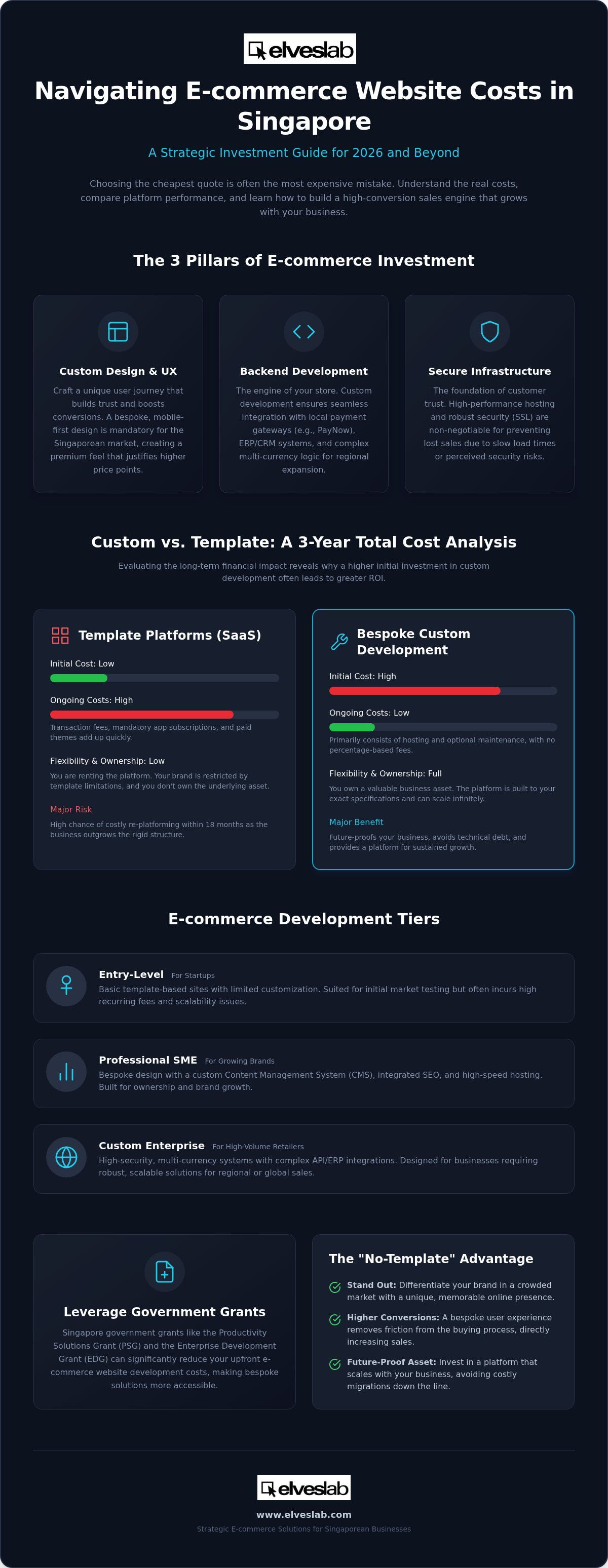
- Learn to budget for the three essential pillars: design, development, and infrastructure. This ensures you build a high-performing digital presence from day one.
- Discover how evaluating the 3-year Total Cost of Ownership reveals the long-term financial benefits of custom development over rigid templates.
- Understand how 2026 government grants like PSG and EDG can significantly reduce your e-commerce website cost Singapore.
- Identify why a bespoke, "no-template" approach is critical for standing out in a competitive market and driving higher conversion rates.
Understanding E-commerce Website Cost in Singapore (2026)
Calculating the e-commerce website cost Singapore businesses face requires looking beyond the initial invoice. It's a technical ecosystem combining creative design, robust backend development, and secure infrastructure. Think of your store as a digital storefront in a prime physical location. It needs to be fast, secure, and ready to handle thousands of concurrent visitors. In the context of e-commerce, your website is often the only touchpoint a customer has with your brand. A national-level business cannot afford a fragile digital presence; it needs a platform that functions as a high-conversion sales engine.
Shift your mindset from seeing a website as an expense to viewing it as a strategic investment. An expense is a cost you swallow. An investment is capital you deploy to generate a return. A high-performing store works 24/7 to convert leads into loyal customers. While prices vary, most projects fall into three tiers: Entry-level for startups, Professional SME for growing brands, and Custom Enterprise for high-volume retailers requiring complex integrations.
Entry-Level vs. Professional E-commerce Solutions
SaaS platforms like Shopify or Wix seem affordable at first. However, transaction fees and monthly app subscriptions stack up quickly. Professional e-commerce development Singapore focuses on ownership and custom logic. This bespoke approach ensures your brand identity isn't restricted by a template's borders. Professional design builds instant trust, which drastically reduces customer bounce rates.
The 2026 Market Landscape for Singapore Digital Agencies
The market has changed significantly. Rising talent costs and inflation have pushed agency rates higher, but the value has also increased. Most modern builds now include AI-integrated features like personalized product recommendations or automated customer support. Choosing a "cheap" provider often leads to technical debt. This eventually forces a costly re-platforming project within 18 months when the site fails to scale. Understanding the e-commerce website cost Singapore agencies provide requires evaluating their ability to future-proof your business.
- Entry-level: Basic templates with limited customization and high recurring fees.
- Professional SME: Bespoke design with integrated SEO, custom CMS, and high-speed hosting.
- Custom Enterprise: High-security, multi-currency systems with complex API and ERP integrations.
The Core Components Driving Your E-commerce Investment
When you evaluate the e-commerce website cost Singapore developers present, it's helpful to see where every dollar goes. We categorize these investments into three main buckets: design, backend functionality, and infrastructure. While marketing is a separate ongoing cost, your initial build must lay the groundwork for SEO and performance. High-performance web hosting and security features like SSL certificates aren't just line items; they're the foundation of customer trust. If your site is slow or looks unsecure, you've lost the sale before the customer even sees your products. Understanding the total e-commerce website cost Singapore retailers expect involves weighing these technical parts against your long-term growth goals.
Custom Web Design and User Experience
Design isn't just about looking pretty. It's about how a user moves through your store. Bespoke design allows you to craft a journey specifically for your target audience, unlike modified templates that force your brand into a pre-existing box. In Singapore, mobile-first responsiveness is mandatory. Most shoppers browse on their phones during their commute, so your site must be flawless on small screens. High-end visual assets and custom animations can increase your initial budget, but they pay for themselves by creating a premium feel that justifies higher price points. A well-designed UI directly impacts your conversion rate by removing friction from the checkout process.
Back-end Development and API Integrations
The engine under the hood determines how far your business can go. Generic plugins often conflict with each other, leading to slow load times or security holes. Custom software development ensures that your store connects seamlessly to local payment gateways like PayNow or sophisticated ERP and CRM systems. If you're planning to sell regionally, the complexity of multi-currency logic and international shipping rules requires precise coding.
A custom CMS website Singapore businesses use provides much tighter control over data than off-the-shelf admin panels. This level of customization is often eligible for support through the Productivity Solutions Grant (PSG), making high-end tech more accessible for SMEs. By choosing custom architecture, you avoid the "plugin bloat" that slows down standard sites. If you're unsure which technical components your specific business model needs, speaking with an experienced e-commerce partner can help clarify your roadmap.
- Design: Bespoke UI/UX, mobile optimization, and visual asset creation.
- Backend: Custom API integrations, payment gateways, and shipping logic.
- Infrastructure: Scalable hosting, SSL security, and database management.
Custom vs. Template E-commerce: A Long-term Cost Analysis
Most business owners focus on the initial sticker price when launching a store. They often overlook the "Template Tax" that accumulates over time. In Singapore's e-commerce market, the competition is too high to rely on a generic storefront that looks like everyone else's. The true e-commerce website cost Singapore retailers face is best measured by the three-year Total Cost of Ownership (TCO). While SaaS templates seem cheaper on day one, the combination of transaction fees, monthly app subscriptions, and limited flexibility often makes them more expensive by year two. A bespoke build removes these recurring "rental" fees, giving you a high-performance asset you actually own.
Technical SEO is another area where custom builds provide a massive financial advantage. Template platforms often have rigid URL structures or bloated scripts that you simply can't remove. A bespoke site allows for the deep ecommerce seo singapore optimization required to rank for competitive search terms. You get full control over schema markup, server-side rendering, and mobile architecture. This level of precision helps you lower your long-term customer acquisition costs by driving consistent organic traffic without the limitations of a pre-set platform.
The Scalability Factor
Major sales events like Double 11 or Black Friday test your site's infrastructure to its breaking point. Template-based sites often struggle with massive concurrent user spikes unless you're paying for an elite enterprise subscription. Bespoke builds are engineered for performance from the ground up. When your business model requires complex logic, custom software development ensures you aren't fighting against a platform's restrictions. You can add new features or integrate new logistics partners without worrying about whether a third-party plugin will crash your entire checkout flow.
Ownership and Platform Lock-in
SaaS platforms have a history of raising their fees with little notice. If your entire business is built on their proprietary system, you're locked in. When you own your code, you own a proprietary asset that adds tangible value to your company's valuation. Maintenance becomes a proactive strategy rather than a reactive scramble. At Elves Lab, we leverage our 25 years of experience to provide a secure, end-to-end experience. We don't just hand over a site; we build a secure ecosystem where you don't have to worry about a random plugin update breaking your site on a busy Friday night. When calculating the e-commerce website cost Singapore agencies quote, always ask who owns the intellectual property at the end of the project.
Leveraging Singapore Government Grants to Offset Development Costs
Launching a digital venture in a competitive market like ours is a bold move. The Singapore government recognizes this. They offer substantial financial support to lower the barrier to entry for businesses willing to innovate. These incentives can drastically reduce the initial e-commerce website cost Singapore SMEs need to budget for. Whether you're a startup or an established retailer, understanding the 2026 grant landscape is essential for maximizing your investment. By aligning your project with national digitalization goals, you can secure a high-performance platform while maintaining a healthy cash flow.
To qualify for most schemes, your business must be registered and operating in Singapore with at least 30% local shareholding. Additionally, your group annual sales turnover should be under S$100 million, or you should employ fewer than 200 people. Choosing a grant-eligible web design company singapore trusts is the first step toward a successful application. A veteran partner understands the technical documentation required to meet the stringent criteria set by Enterprise Singapore.
PSG vs. EDG: Which Grant Should You Apply For?
The Productivity Solutions Grant (PSG) remains the most popular choice for standard e-commerce setups. In 2026, the PSG covers up to 50% of the costs for adopting pre-approved digital solutions, with a cap of S$30,000 per company. It's designed for businesses looking to implement proven, scalable systems quickly. However, if your vision involves a bespoke, high-impact digital transformation, the Enterprise Development Grant (EDG) is more suitable. The EDG supports larger projects that require custom software or extensive backend integration. Be aware that in the second half of 2026, the government will consolidate these into the new EDGE (Enterprise Development and Growth for Enterprises) grant to simplify the process for all SMEs.
The Application Process and Timeline
Don't rush into a contract before your paperwork is in order. You must submit your application through the Business Grants Portal and receive a Letter of Offer before any work begins. A common pitfall is paying a deposit or signing a project agreement too early. This often leads to automatic grant rejection. The process typically moves from a formal quotation to application, approval, implementation, and finally, the claim submission. Working with an experienced agency like Elves Lab ensures your project milestones are clearly defined for grant compliance. We help you navigate the administrative requirements so you can focus on your business strategy. To get started, you should check your eligibility with Elves Lab today.
- PSG: Best for standard setups; covers up to 50% of costs.
- EDG: Ideal for bespoke, complex digital transformation projects.
- EDGE: The upcoming consolidated grant launching in late 2026.
Why Elves Lab is the Strategic Choice for Bespoke E-commerce
Choosing a partner for your digital transformation is about more than just comparing the initial e-commerce website cost Singapore agencies provide. It's about finding a team that understands the local landscape and has the longevity to support your growth. Elves Lab was founded in 2000. With over 25 years of experience, we've seen every major shift in Singapore's digital economy. Our "No Template" philosophy isn't just a design choice; it's a commitment to ensuring your brand stands out in a crowded market. We don't believe in squeezing your unique business vision into a pre-made box. Instead, we build from the ground up to ensure every pixel serves a specific business purpose.
Our End-to-End Development Process
We treat every project as a strategic collaboration rather than a one-off transaction. Our process starts with deep discovery and strategy sessions. We align our technical choices with your specific revenue drivers to ensure the final product delivers a tangible return. Bespoke development means we write high-performance code that results in faster load times and tighter security. Once your store is live, our partnership continues. We provide robust web hosting, ongoing maintenance, and growth marketing to keep your site ahead of the competition at all times.
Maximizing ROI Beyond the Launch
A great website should empower your team, not hold them back with technical limitations. Our custom CMS allows your staff to manage content and products effortlessly without needing developer help for every small update. We also bake SEO singapore best practices into the core of your site's architecture. This ensures you start generating organic traffic from day one. To stay ahead in 2026, we integrate cutting-edge tools like AI video generation Singapore retailers use to create high-conversion product demonstrations. This future-proofs your store and helps you dominate both search and social media channels.
Investing in a bespoke solution is the most effective way to lower your long-term e-commerce website cost Singapore. You avoid the "template tax" and build a proprietary asset that adds real value to your company. Ready to build something unique that drives results? You can Get a custom e-commerce quote from Elves Lab today and start your journey toward a scalable, high-performance online store.
Future-Proof Your Brand with Strategic Digital Investment
Building an online store is more than just a technical launch; it's about creating a scalable business asset. You now understand that the true e-commerce website cost Singapore businesses encounter isn't just the upfront quote. It involves balancing design, custom backend logic, and long-term ownership. By leveraging 2026 government grants like the PSG or the upcoming EDGE scheme, you can significantly lower your initial capital outlay while securing a platform that outperforms generic templates.
Elves Lab has been a dedicated partner in the Singaporean digital space since 2000. We specialize in bespoke, non-template solutions that give your brand a unique edge. Our team provides full grant application support, ensuring you navigate the administrative process with confidence. Don't let confusing price variations or hidden fees hold your business back. It's time to transform your vision into a high-conversion sales engine.
Request a Bespoke E-commerce Strategy Session with Elves Lab and take the first step toward a store that truly grows with you. We're excited to help you build something extraordinary.
Frequently Asked Questions
How much does a basic e-commerce website cost in Singapore in 2026?
Market reports for 2026 suggest a professionally built Shopify store ranges between S$7,000 and S$12,000 for the first year. For more robust agency-developed platforms, budgets often start at S$6,000 and can exceed S$20,000 depending on complexity. While DIY platforms have low entry fees, these often come with higher transaction costs. Investing in a professional build ensures your site is optimized for conversion from the very first day.
Can I use the PSG grant for a custom e-commerce website?
Yes, you can utilize the Productivity Solutions Grant (PSG) for pre-approved e-commerce solutions, which covers up to 50% of the costs. If your project involves high-impact digital transformation or proprietary software logic, the Enterprise Development Grant (EDG) is often more appropriate. These grants significantly lower the initial e-commerce website cost Singapore businesses must bear. It's crucial to work with a grant-eligible vendor to ensure your application meets all technical criteria.
How long does it take to build a bespoke e-commerce store?
A bespoke e-commerce project typically takes between 8 to 16 weeks to complete. This timeline includes discovery, custom UI/UX design, backend development, and rigorous testing. Standard template-based sites might launch faster, but they often lack the performance optimization of a custom build. Taking the time for a bespoke process ensures your store handles high traffic volumes and integrates perfectly with your existing inventory and accounting software for smoother operations.
What are the recurring costs for an e-commerce website in Singapore?
Beyond the initial build, you should budget for domain registration (S$10 to S$30 annually) and secure web hosting (S$5 to S$250 monthly). Payment processing fees are often the largest recurring expense, typically ranging from 3.2% to 3.4% per transaction. Additionally, ongoing maintenance and security updates are essential to protect customer data. Factoring these into your e-commerce website cost Singapore planning prevents unexpected financial strain as your business scales.
Is custom development better than Shopify for a small business?
Shopify is excellent for rapid testing, but custom development is often better for businesses seeking long-term ownership and lower transaction fees. Custom sites allow for unique features that aren't limited by a platform's app ecosystem. You avoid monthly subscription hikes and "template tax" when adding advanced functionality. For a small business with aggressive growth plans, a bespoke build provides the technical freedom to scale without being locked into a proprietary system's rules.
What features are included in a standard e-commerce development package?
A standard professional package typically includes a custom content management system (CMS), mobile-responsive design, and secure payment gateway integration for methods like PayNow. It also covers product catalog setup, automated order notifications, and basic search engine optimization. More advanced packages might include multi-currency support, AI-driven product recommendations, or integration with third-party ERP systems. Every feature is chosen to reduce friction during the customer's journey and maximize your overall sales potential.
Do I need to pay for web hosting separately?
Yes, web hosting is a separate infrastructure cost required to keep your store online. While some SaaS platforms include hosting in their monthly subscription, bespoke builds require high-performance servers to ensure fast load times. Elves Lab provides integrated web hosting services, allowing you to manage your site and infrastructure through a single partner. This end-to-end approach ensures your hosting environment is specifically optimized for your site's custom code and security requirements.
How does SEO affect the overall cost of my e-commerce project?
Integrated SEO increases the initial development cost but drastically reduces your future marketing expenses. When SEO is optimized during the build phase, your site architecture is ready for search engine crawling and user intent. This means you won't need to pay for expensive technical fixes later. A site built with search visibility in mind generates organic traffic sooner, helping you achieve a faster return on your total e-commerce investment.
Disclaimer
AI-Generated Content Disclaimer
The articles, blog posts, and informational content published on this website may be generated or assisted by artificial intelligence (AI) tools for search engine optimisation (SEO), content discovery, and informational purposes.
While reasonable efforts are made to ensure the content is relevant and useful, the information provided may not always be accurate, complete, current, or applicable to your specific circumstances. The views, opinions, statements, recommendations, or interpretations expressed in these articles are generated based on publicly available information and do not necessarily reflect the views, opinions, positions, policies, or professional advice of our company, its management, employees, partners, or affiliates.
The content should not be construed as legal, financial, medical, technical, professional, or other specialised advice. Readers are encouraged to independently verify any information and seek professional consultation where appropriate before making decisions based on the content provided.
Our company shall not be held liable for any loss, damage, claim, or consequence arising directly or indirectly from the use of, reliance upon, or interpretation of any AI-generated content published on this website.
By accessing and using this website, you acknowledge and accept that certain content may be generated or assisted by AI technologies and is provided on an "as is" basis for informational and SEO purposes only.