The "safe" bet of a platform giant might actually be the biggest risk to your S$100 million GMV goals. When evaluating shopify plus vs custom e-commerce for high-volume enterprise brands in Singapore, the choice isn't just about features. It's about whether your competitive advantage lives in the product you sell or the unique way you sell it. You've likely felt the sting of transaction fees eating into your margins or the frustration of a checkout logic that won't bend to your ERP's requirements. We understand that scalability isn't just about staying online during a flash sale; it's about maintaining total control over your data and customer experience.
This guide provides a technical and strategic deep dive into the 2026 enterprise landscape. You'll discover how to weigh the rapid deployment of Shopify Plus against the zero vendor lock-in and bespoke scalability of a custom-built system. We'll break down the total cost of ownership, integration frameworks for complex CRM systems, and how to avoid the technical debt that often haunts large-scale migrations. By the end, you'll have a clear roadmap to choose the architecture that supports your next decade of growth.
Key Takeaways
- Understand why processing over 10,000 daily orders in 2026 requires a shift toward composable commerce and high-performance architecture.
- Evaluate shopify plus vs custom e-commerce for high-volume enterprise to decide if speed to market or total architectural ownership is your top priority.
- Analyze how transaction fees on S$100 million+ GMV can make "rented" platforms more expensive than bespoke systems over time.
- Audit your business's "secret sauce" to determine if your competitive edge requires a platform that bends to your unique ERP and CRM logic.
- Learn how to bake e-commerce SEO directly into your core storefront code to avoid the limitations of standard templates and plugins.
The 2026 Enterprise E-commerce Landscape: High Volume Requirements
The enterprise e-commerce sector has evolved rapidly. By 2026, high-volume performance is measured by the ability to process over 10,000 orders daily while managing complex multi-currency settlements and headless architectures. It's no longer enough to just have a storefront; your system must act as a high-speed engine for growth. When comparing shopify plus vs custom e-commerce for high-volume enterprise brands, the distinction lies in where the "glass ceiling" sits for your specific business model.
Standard SaaS models often struggle with proprietary logic. If your business requires a specific checkout flow or deep ERP synchronization that doesn't fit a template, you'll eventually hit a wall. Modern e-commerce platforms are shifting toward Composable Commerce. This approach allows you to pick the best tools for each job rather than relying on a monolithic suite. For Singaporean enterprises, this flexibility is vital to stay competitive in a market that demands local precision and global speed.
Data sovereignty has become a non-negotiable requirement. Owning your data and the logic that processes it ensures you aren't at the mercy of a third-party provider's roadmap. This independence allows for a more agile response to local regulatory changes or shifts in consumer behavior. Building a system that you own entirely provides a level of security and long-term stability that rented platforms simply can't match.
Defining High-Volume Performance Standards
Uptime isn't a luxury; it's a survival metric. At enterprise scale, even a one-minute outage during a peak sale can result in thousands of dollars in lost revenue. You also have to consider API rate limits. If your backend systems can't talk to each other fast enough because your platform throttles the connection, your growth stops. Choosing between shopify plus vs custom e-commerce for high-volume enterprise involves auditing these technical constraints to ensure your national infrastructure can handle global demand without slowing down.
The Rise of Agentic Commerce
Fulfillment is no longer just about humans in a warehouse. AI agents now manage inventory, customer queries, and even predictive restocking in real-time. Your platform must support these integrations at a core level. Bespoke logic allows you to train AI models on your specific brand data. This creates a more personalized experience for your customers. Closed-loop systems often limit how deeply these agents can interact with your core database, making custom development the preferred choice for those looking to lead in AI-driven retail.
Shopify Plus vs. Custom E-commerce: Strategic Comparison
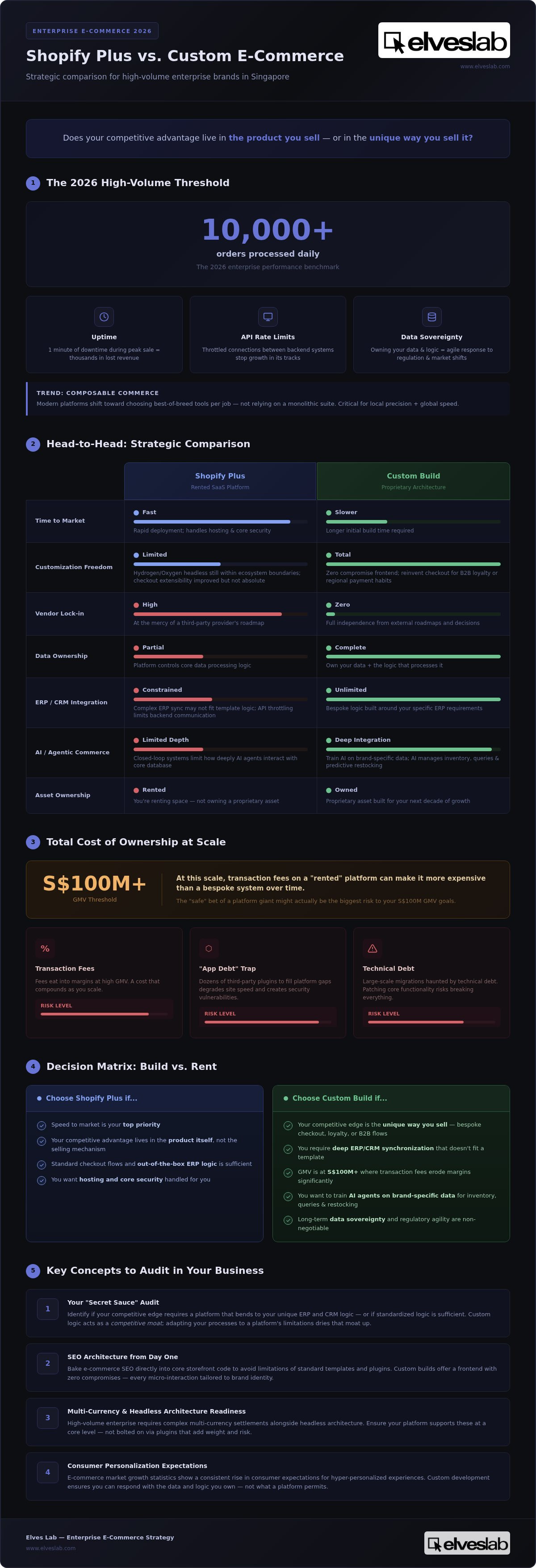
Choosing between shopify plus vs custom e-commerce for high-volume enterprise models often comes down to a trade-off between convenience and competitive sovereignty. Shopify Plus offers remarkable speed to market. It's a robust SaaS solution that handles the heavy lifting of hosting and core security. However, this convenience comes with long-term customization constraints. As your business scales, you may find that the platform’s standardized logic doesn't protect your unique operational "secret sauce." Custom logic acts as a competitive moat; once you're forced to adapt your processes to fit a platform's limitations, that moat begins to dry up.
Custom development demands a longer initial build time but provides total ownership. You aren't just renting space; you're building a proprietary asset. This is critical when you consider e-commerce market growth statistics that show a consistent rise in consumer expectations for hyper-personalized experiences. For enterprises with S$100M+ GMV, the "App Debt" trap is a significant risk. Relying on dozens of third-party plugins to fix platform gaps eventually degrades site speed and creates security vulnerabilities that are difficult to patch without affecting core functionality.
Customization and Frontend Flexibility
While Shopify’s Hydrogen and Oxygen frameworks offer headless capabilities, they still operate within the ecosystem's fundamental boundaries. A true custom web design Singapore approach allows for a frontend built with zero compromises. You can tailor every micro-interaction to your brand's specific identity. This freedom is vital in the checkout process. Shopify Plus has improved checkout extensibility, but it still lacks the absolute flexibility of a custom build where you can reinvent the transaction flow to match complex B2B loyalty requirements or unique regional payment habits.
Backend Logic and Third-Party Integrations
Enterprise efficiency often hinges on how well your storefront talks to your legacy systems. Integrating a decades-old ERP with a modern SaaS platform often requires expensive middleware that acts as a translator. Sometimes, this middleware becomes more costly and prone to failure than the platform itself. This is why web application development Singapore is the preferred route for businesses with multi-tier pricing or intricate wholesale rules. Security and compliance also differ. With Shopify, you trust their global standards. With a custom system, you govern your own security protocols to meet specific Singaporean data laws. If you're ready to build a system that truly scales with your vision, our team at Elves Lab can help you architect a solution that lasts.
Analyzing Total Cost of Ownership (TCO) at Scale
When you're comparing shopify plus vs custom e-commerce for high-volume enterprise operations, the financial math shifts significantly once you hit eight-figure revenues. At S$100 million GMV, even a seemingly small 0.15% or 0.20% transaction fee results in hundreds of thousands of dollars paid out annually just for the privilege of processing orders. This "success tax" is often the catalyst for large-scale migrations. While SaaS provides a predictable monthly bill, it often masks a series of escalations that eat into your margins as you grow. You aren't just paying for a platform; you're paying a percentage of your growth back to the provider.
According to recent enterprise e-commerce market statistics, the cost of customer acquisition is rising across all sectors. This makes backend efficiency your last line of defense for maintaining profitability. In a custom ecosystem, your investment in e-commerce development singapore shifts from a recurring operating expense to a long-term capital asset. You own the code. You own the logic. Most importantly, you aren't paying extra fees every time your marketing team hits a home run and spikes your sales volume.
The SaaS "Success Tax"
Revenue sharing models are designed to be accessible for growing brands, but they rarely stay cost-effective at the highest levels of enterprise scale. For a Singaporean enterprise, the cumulative cost of transaction penalties, monthly licensing, and premium app subscriptions can quickly exceed the cost of maintaining a bespoke system. Custom builds allow you to reinvest those saved fees into proprietary features that actually drive conversion. You're building equity in your own digital platform rather than funding a vendor's product roadmap.
Scalability Costs: Infrastructure vs. Licensing
Scaling for massive traffic spikes during 11.11 or Chinese New Year shouldn't mean paying for unused capacity the rest of the year. SaaS platforms often bundle their infrastructure costs into high-tier licensing, giving you less control over the underlying resources. With bespoke architecture, you can leverage reliable web hosting solutions that scale dynamically based on real-time demand. You pay for the server power you use, not a flat percentage of your revenue. This granular control allows for deep performance optimization, ensuring your site stays lightning-fast even when thousands of users hit the checkout simultaneously.
Decision Matrix: When to Build vs. When to Rent
Deciding between shopify plus vs custom e-commerce for high-volume enterprise operations requires more than a feature comparison. It's a strategic audit of your business's future. To make the right choice for 2026, you must look past the initial setup and evaluate how your platform choice will impact your agility over the next three to five years. If your business processes are standard, renting is efficient. If your processes are your competitive advantage, building is a necessity.
Follow these five steps to determine your path:
- Audit your "Secret Sauce": Is your competitive edge in the products you sell or the unique way you handle fulfillment, loyalty, or B2B pricing? If it's the latter, a template-based platform will eventually stifle you.
- Evaluate integration complexity: Count how many "hacks" or middleware layers Shopify requires to talk to your ERP. If you're building bridges every time you want to sync data, the architecture is failing you.
- Project 3-year GMV: Forecast your transaction fees. When your annual payout to a platform exceeds the cost of a full-time senior developer, the "rent" is too high.
- Assess internal capabilities: Do you have the team to maintain a custom build, or do you need a dedicated partner to handle the technical heavy lifting?
- Define your growth strategy: Determine if your brand needs a bespoke digital growth approach that allows for total frontend and backend freedom.
Identifying the Breaking Point
There's a specific moment when Shopify Plus moves from an asset to a bottleneck. You'll notice it when new feature deployments take longer because of plugin conflicts or when performance lags during high-traffic Singaporean sales events like 11.11. This is the "Moat" test. If a competitor can replicate your entire digital workflow just by installing the same three Shopify apps, you don't have a technical moat. Custom builds allow you to deploy proprietary logic that competitors simply cannot buy off the shelf.
Risk Assessment for Enterprise Migration
Migration is the biggest fear for enterprise leaders. The risk of data loss or downtime can be paralyzing. However, a structured migration strategy ensures zero downtime by running systems in parallel during the transition. Preserving your Google ranking is equally critical. You need a partner who understands that every URL redirect and metadata tag must be mapped perfectly to prevent a post-launch traffic collapse. If you're hitting the limits of your current setup, contact Elves Lab today to discuss a risk-free transition to a custom architecture.
Future-Proofing Your Storefront with Elves Lab
Choosing between shopify plus vs custom e-commerce for high-volume enterprise models isn't just a technical decision; it's a commitment to your brand's operational freedom. At Elves Lab Pte Ltd, we've spent over two decades acting as the architects for businesses that have outgrown the "glass ceilings" of standard SaaS platforms. We prioritize bespoke engineering because we believe your software should adapt to your business, not the other way around. By removing the constraints of restrictive templates, we empower Singaporean enterprises to build proprietary assets that drive genuine efficiency and zero vendor lock-in.
A high-performance storefront requires more than just a fast checkout. It needs a foundation where visibility is baked into the source code. We integrate e-commerce seo singapore strategies directly into your core architecture. This ensures your platform is ready for the AI-driven discovery era of 2026. Instead of relying on heavy plugins that degrade page speed, our custom-built systems use clean, optimized code that search engines and AI agents can crawl with ease. This proactive approach to digital growth ensures your enterprise remains visible in an increasingly crowded national market.
The Elves Lab Pte Ltd Custom Build Process
Our methodology begins far beyond the user interface. We start with deep business logic mapping to understand how your storefront interacts with your warehouse, ERP, and CRM systems. This ensures every line of code serves a specific operational goal. As we look toward 2026, we focus on building AI-ready, mobile-first architectures that can handle massive traffic spikes without a second of downtime. We treat your platform as a living organism, designed to evolve as new technologies emerging, ensuring you're never trapped by legacy code or outdated third-party dependencies.
Beyond the Launch: Partnership and Support
Building a custom platform is a journey, not a one-time event. We provide managed hosting and security protocols tailored specifically to enterprise requirements, giving you the peace of mind to focus on scaling your GMV. Our relationship doesn't end when the site goes live. We offer iterative development to ensure your system grows alongside your business. Whether you're expanding into new regional markets or integrating advanced fulfillment agents, our team provides the continuous support needed to maintain your competitive edge. Ready to take total control of your digital future? Scale your enterprise e-commerce with a custom solution from Elves Lab Pte Ltd.
Owning Your Digital Destiny in 2026
The choice between shopify plus vs custom e-commerce for high-volume enterprise brands isn't just about the next quarter; it's about the next decade of growth. As we've explored, the "rented" convenience of SaaS platforms eventually hits a glass ceiling where transaction fees and rigid logic stifle innovation. By shifting toward a bespoke architecture, you transform your digital storefront from a recurring operating expense into a proprietary capital asset that protects your unique business processes. You gain the freedom to integrate complex ERP systems and deploy brand-specific AI models without platform-imposed limits.
With over 25 years of custom development expertise, Elves Lab specializes in building high-performance, non-template systems that integrate SEO and digital marketing directly into the core. We don't just build websites; we architect scalable engines designed for S$100M+ growth. Our approach ensures zero vendor lock-in and a platform that scales perfectly with your national and global ambitions.
Consult with Elves Lab for a Bespoke Enterprise E-commerce Strategy
Your vision deserves a platform that bends to your will, not the other way around. Let's build something extraordinary together.
Frequently Asked Questions
Is Shopify Plus truly "limitless" for high-volume enterprise stores?
No, it isn't. While Shopify Plus handles massive traffic, its API rate limits and Liquid-based architecture create bottlenecks for complex integrations. When comparing shopify plus vs custom e-commerce for high-volume enterprise brands, the "limit" is usually found in how much you can customize the checkout or backend logic. Truly bespoke systems don't have these vendor-imposed restrictions, allowing your unique business logic to dictate the platform's behavior rather than the other way around.
What is the average build time for a custom enterprise e-commerce platform in 2026?
A custom enterprise build usually requires four to eight months. This timeline reflects the depth of discovery, business logic mapping, and bespoke engineering needed for high-performance systems. While Shopify Plus offers a faster initial launch, the custom route focuses on building a proprietary asset that avoids technical debt. It's a strategic investment in a platform that won't need a total overhaul every few years as your requirements evolve and your volume grows.
How do transaction fees compare between Shopify Plus and a custom build at S$50M+ GMV?
The difference is substantial once you scale. Shopify Plus transaction fees can reach S$150,000 or more annually at S$50M GMV. Custom builds eliminate these per-transaction penalties entirely. You pay for the development and reliable web hosting rather than a "success tax" on your growth. Over a three-year period, the savings on transaction fees alone often cover the entire cost of a custom build, making it the more profitable long-term choice.
Can a custom e-commerce site match Shopify’s security standards?
Absolutely. Custom architectures allow you to implement self-governed security standards that align with Singapore’s specific data protection regulations. While Shopify manages global security, a custom build gives you granular control over server-side protocols and data sovereignty. You aren't sharing a security framework with millions of other stores. This isolation often makes custom systems more resilient against broad attacks that target SaaS platforms, providing enterprise-level peace of mind.
Do I need a custom CMS if I move away from Shopify Plus?
A bespoke Content Management System (CMS) is essential for maintaining control. When you move away from Shopify, a custom CMS ensures your team can still update product pages and marketing content without technical help. Elves Lab builds these systems from scratch to match your specific workflow. This removes the bloat of standard templates and ensures your backend is as fast and efficient as your frontend storefront, supporting your internal team's productivity.
What are the SEO implications of switching from Shopify to a custom platform?
Switching provides a significant opportunity to improve your search visibility. Custom platforms allow you to optimize core code and URL structures that are often rigid in Shopify. We integrate e-commerce SEO directly into the architecture during the build phase. This ensures your site is ready for both traditional search and modern AI discovery. Proper migration mapping prevents any loss in ranking while setting a much higher performance ceiling for your organic traffic.
How does Elves Lab handle ERP and CRM integrations for bespoke builds?
We start with a comprehensive audit of your business logic. Our team builds direct, high-speed connections between your storefront and existing systems like SAP or Microsoft Dynamics. This avoids the expensive middleware often required to make Shopify talk to legacy ERPs. By engineering these integrations at the core level, we ensure real-time data accuracy for inventory, pricing, and customer records across your entire enterprise ecosystem without relying on fragile third-party bridges.
Is headless commerce possible with both Shopify Plus and custom builds?
Headless is possible on both, but the level of freedom differs. Shopify’s Hydrogen framework still tethers you to their backend and transaction fees. A custom headless build offers zero vendor lock-in. You can use any frontend framework and any backend logic you choose. This is often the preferred route for enterprises that need total control over the customer experience and data ownership without platform-imposed constraints or recurring revenue-sharing models.
Disclaimer
AI-Generated Content Disclaimer
The articles, blog posts, and informational content published on this website may be generated or assisted by artificial intelligence (AI) tools for search engine optimisation (SEO), content discovery, and informational purposes.
While reasonable efforts are made to ensure the content is relevant and useful, the information provided may not always be accurate, complete, current, or applicable to your specific circumstances. The views, opinions, statements, recommendations, or interpretations expressed in these articles are generated based on publicly available information and do not necessarily reflect the views, opinions, positions, policies, or professional advice of our company, its management, employees, partners, or affiliates.
The content should not be construed as legal, financial, medical, technical, professional, or other specialised advice. Readers are encouraged to independently verify any information and seek professional consultation where appropriate before making decisions based on the content provided.
Our company shall not be held liable for any loss, damage, claim, or consequence arising directly or indirectly from the use of, reliance upon, or interpretation of any AI-generated content published on this website.
By accessing and using this website, you acknowledge and accept that certain content may be generated or assisted by AI technologies and is provided on an "as is" basis for informational and SEO purposes only.