Staying on a platform that forces you into a massive annual maintenance cycle just to keep the lights on isn't a growth strategy; it's a hostage situation. You've likely felt the sting of Magento's rigid database model slowing your site to a crawl, particularly as Adobe Commerce 2.4.6 reached its total End of Life in August 2026. It's natural to seek the freedom of a bespoke solution, yet ignoring the magento to custom e-commerce platform migration risks can turn your dream of autonomy into a technical nightmare.
We understand the frustration of trying to implement unique business logic on a platform that fights you at every turn. This guide identifies the critical pitfalls, from preserving SEO link equity for the mandatory twelve-month period to meeting strict PCI DSS v4.0.1 requirements for client-side script monitoring. We'll show you how to mitigate these operational and technical threats while transitioning to a lean, high-performance architecture. You'll learn how to extract your core logic and map complex data schemas without losing a single customer record or search ranking.
Key Takeaways
- Learn why performance-driven brands are escaping the high overhead of legacy systems to reclaim innovation through streamlined, bespoke architectures.
- Master the transition from complex EAV database models to clean custom schemas without corrupting critical product relationships or attribute sets.
- Identify and mitigate the most dangerous magento to custom e-commerce platform migration risks, including the hidden "feature gap" in promotions and discount logic.
- Protect your search visibility and revenue by mapping legacy URL structures to new paths, preventing 404 spikes and preserving long-term link equity.
- Discover how a risk-first architectural discovery process ensures your new platform serves as a hedge against platform inflation and technical bloat.
Why Move from Magento to Custom? Identifying the 2026 Tipping Point
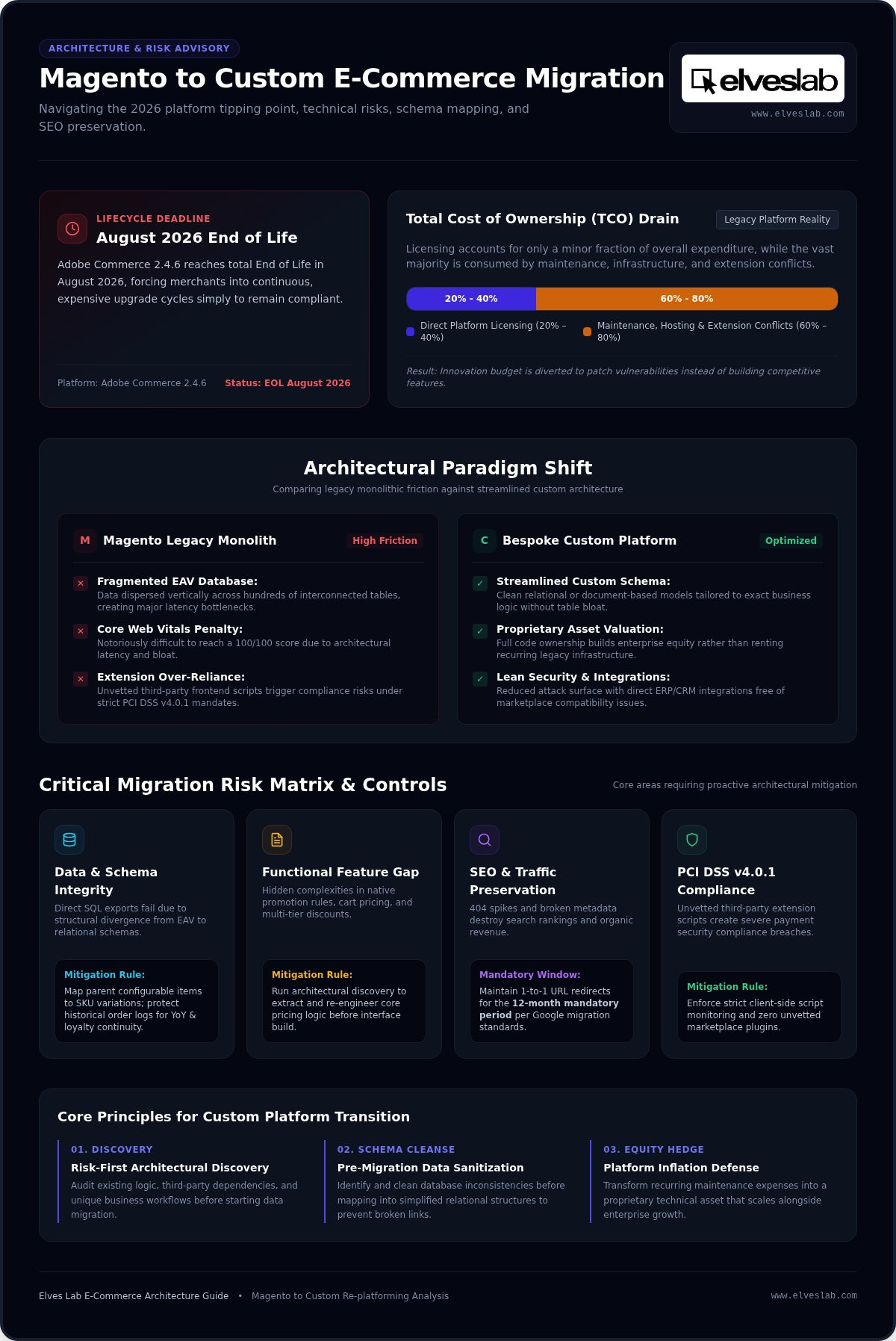
Brands are waking up to the reality that legacy systems are draining their innovation budgets. By 2026, the treadmill of security patches and version upgrades has become unsustainable for many. Adobe Commerce 2.4.6 reached its total End of Life in August 2026, forcing merchants into yet another costly upgrade cycle just to stay compliant. Licensing for these platforms often represents only 20% to 40% of the total cost of ownership. The remaining 60% to 80% vanishes into maintenance, hosting infrastructure, and fixing endless extension conflicts.
This financial drain prevents businesses from building the unique features they actually need to compete. Instead of creating new customer experiences, teams spend their time patching vulnerabilities or managing infrastructure. While the benefits of moving away are clear, understanding the magento to custom e-commerce platform migration risks is the first step toward a successful transition. You can't just flip a switch; you need a strategic roadmap to ensure your business logic remains intact during the shift.
The Limitations of One-Size-Fits-All Platforms
Achieving a 100/100 Core Web Vitals score on Magento is notoriously difficult. Its monolithic architecture and complex EAV database model create inherent latency that affects conversion rates. Most stores rely on a mountain of third-party extensions to function. These plugins often inject unvetted scripts into your frontend. This not only slows down the site but also creates massive security headaches under PCI DSS v4.0.1 requirements, which now mandate strict monitoring of all client-side scripts.
The Strategic Shift to Bespoke Software
Transitioning to bespoke software allows for full code ownership. This shift increases your company's valuation because you aren't just renting a platform; you're building a proprietary asset. During the data migration process, you can strip away the bloat and design a schema that matches your specific business logic. This results in a leaner, faster platform that integrates seamlessly with your existing ERP or CRM systems without the friction of marketplace compatibility issues.
A bespoke approach isn't just about speed; it's about control. You decide when to upgrade and what features to prioritize. By removing the extension bloat common in marketplace ecosystems, you reduce your attack surface and improve stability. We believe that custom development is the ultimate solution to Magento bloat. It allows you to build a platform that grows with you, rather than one you eventually outgrow. Mastering the magento to custom e-commerce platform migration risks ensures this journey doesn't compromise your existing revenue streams.
Critical Technical Risks: Data Integrity and Schema Mapping
The most daunting technical hurdle in any re-platforming project is the structural chasm between Magento’s database and a bespoke solution. Magento utilizes an Entity-Attribute-Value (EAV) architecture, a model that stores product data in a fragmented, vertical fashion across hundreds of interconnected tables to allow for infinite attribute flexibility. While this flexibility is Magento's hallmark, it creates significant performance bottlenecks and makes the magento to custom e-commerce platform migration risks particularly high during the extraction and transformation phases.
Transformation isn't a simple copy-paste job. You're moving from a monolithic structure to a streamlined relational or document-based schema. If the mapping logic isn't perfect, you risk losing complex product relationships, such as the links between configurable parent items and their specific SKU variations. Historical order data also requires careful handling. Without it, your customer loyalty programs and year-over-year analytics will lose their continuity, leaving your marketing team flying blind after the launch.
Managing Database Architecture Shifts
Direct SQL exports frequently fail in these migrations because the destination schema is fundamentally different. Successful transitions require a rigorous data cleaning phase to identify and fix inconsistencies before they move. According to Google's documentation on site moves with URL changes, maintaining structural integrity is vital for search engines to understand your new architecture. Failing to validate data at this stage can lead to broken internal links or missing metadata that tanks your rankings.
Then there's the issue of security. Magento stores customer passwords using specific hashing algorithms like Argon2ID13. Since you can't decrypt these, your custom platform needs an authentication hook to verify legacy hashes on a customer's first login before re-hashing them into your new standard. This ensures a seamless experience where users don't have to reset their passwords unless absolutely necessary.
Security and Compliance During Transition
Operating in Singapore means you must adhere to strict PDPA regulations throughout the migration. Data must remain encrypted during the "dual-running" phase when both the old and new systems might access the same customer records via APIs. Ensuring your new custom infrastructure meets the mandatory requirements of PCI DSS v4.0.1 is also a non-negotiable step for maintaining payment processing rights. This complexity is why many brands choose to partner with e-commerce development experts who manage the entire data lifecycle from extraction to validation.
Functional Parity Risk: Replicating Magento Logic
Moving to a bespoke platform isn't about matching Magento feature-for-feature. It's about business logic extraction. Many brands fall into the "Feature Gap" trap by assuming every native Magento function is essential to their operation. In reality, much of that native code contributes to the platform bloat that slows down your conversions. Identifying the specific magento to custom e-commerce platform migration risks involves an audit of your actual daily usage. Don't waste resources building a complex tiered-pricing engine if your business only uses flat discounts.
Replicating promotional logic is where most custom builds stumble. Magento’s cart price rules allow for deeply nested boolean conditions that are difficult to map. If your marketing team relies on specific customer group discounts or "Buy X, Get Y" bundles, these must be architected into your new core from day one. This is also the perfect time to streamline your checkout experience. You can remove the multi-step friction of legacy systems while maintaining high security standards. It's a strategic translation of your sales playbook into a leaner, more responsive engine.
Mapping Core E-commerce Functionality
Managing inventory across multiple warehouses or channels requires a robust API-first approach. Unlike Magento's heavy EAV-based inventory tables, a custom solution can use streamlined relational schemas for near-instant updates. You also need to account for transactional email workflows. Every notification trigger, from order confirmations to shipping updates, must be rebuilt to match your brand voice. Referencing the Google Search Central guide on site moves with URL changes helps ensure that as you re-engineer these functional pieces, you maintain the structural integrity needed for search crawlers to index your new site correctly.
Bespoke CMS vs. Magento Admin
Transitioning your team from the cluttered Magento backend to a custom CMS website Singapore is a significant operational shift. While a bespoke interface improves efficiency by removing irrelevant menus and tabs, it requires a brief training period for your staff. The goal is to give your marketing team the flexibility they need to launch campaigns without compromising site stability. A well-designed custom admin panel lets you manage content and products in seconds rather than minutes. This operational speed is a key outcome of mitigating magento to custom e-commerce platform migration risks by focusing on usability over generic complexity.
SEO and Traffic Preservation: Protecting Your Search Visibility
A website migration is often the moment when organic revenue hangs in the balance. Magento handles URL rewrites through a specific table structure that often includes legacy .html suffixes or deeply nested category paths. Moving to a bespoke platform is your opportunity to clean these up, but failing to map them correctly is one of the most significant magento to custom e-commerce platform migration risks. A sudden spike in 404 errors can signal to search engines that your site is no longer reliable, leading to a swift drop in rankings.
Preserving your hard-earned authority requires more than just technical skill; it requires a meticulous audit of your existing equity. You must carry over every meta description, alt tag, and schema markup snippet to the new environment. This level of detail is especially critical for high-traffic e-commerce development Singapore projects where there's no room for error. If your internal linking structure breaks during the move, your most valuable pages may lose the link juice they need to stay on page one.
The Technical SEO Migration Checklist
Success lies in the execution of your redirect strategy. Google mandates that 301 redirects remain active for at least 12 months after a move to ensure full signal consolidation. Don't rely on blanket redirects to your homepage. These are often flagged as soft 404s and won't preserve your rankings. Instead, follow these steps:
- Implement 1:1 redirects for every single indexed URL in your catalog.
- Update your XML sitemaps and robots.txt files immediately upon launch.
- Monitor Google Search Console for crawl errors every hour during the first 48 hours.
Speed and Performance as an SEO Gain
The beauty of custom code is the ability to crush Core Web Vitals targets that Magento simply can't reach. By stripping away the "version treadmill" bloat, you can achieve a significantly reduced Time to First Byte (TTFB). This performance boost acts as a buffer. Even if there's minor volatility during the move, a faster, more responsive site often sees a long-term ranking improvement. For those looking to push their visibility even further, our guide on ecommerce seo singapore covers advanced AI discovery and search dominance strategies.
Protecting your traffic doesn't have to be a gamble. You can consult with our SEO-first development team to build a migration roadmap that keeps your revenue growing.
Strategic Risk Mitigation with Elves Lab
We don't believe in one-size-fits-all solutions because your business logic is unique. At Elves Lab, our approach to mitigating magento to custom e-commerce platform migration risks starts with a risk-first discovery phase. We analyze your existing architecture to identify technical debt and "hidden" dependencies before a single line of code is written. This architectural planning ensures your new bespoke system isn't just a replacement; it's a strategic upgrade designed for the performance demands of 2026.
Bespoke software serves as a powerful long-term hedge against platform inflation. While monolithic systems often demand rising licensing fees for stagnant value, a custom build gives you total ownership. You stop paying for features you don't use and start investing in proprietary assets that increase your company's valuation. We provide end-to-end support, from initial creative design to reliable web hosting Singapore, ensuring your platform remains stable and secure under high traffic loads.
Our team aligns every custom build with national e-commerce growth strategies and local standards. We ensure your system is ready for localized payment integrations while maintaining strict compliance with Singapore's evolving data protection standards. This localized expertise removes the friction of trying to force a global template to work in a specific regional market. We treat your migration as a partnership, acting as the technical mentor that guides you through every complexity.
A Phased Migration Roadmap
We recommend a phased approach to minimize operational disruption. This often begins with a Minimum Viable Product (MVP) launch, focusing on your core revenue-generating features first. Our rigorous User Acceptance Testing (UAT) protocols for bespoke builds ensure every custom-coded workflow performs flawlessly before the legacy system is switched off. Post-launch, we provide iterative development cycles to refine the platform based on real-time customer data and feedback.
Partnering for Digital Excellence
Leveraging our 26 years of experience in the Singaporean digital landscape, we've refined a process that eliminates common deployment errors. Our specialized web application development Singapore expertise allows us to build high-performance tools that integrate perfectly with your existing stack. We take the burden of the magento to custom e-commerce platform migration risks off your shoulders so your team can focus on what they do best: growing the brand.
Ready to leave Magento behind? Consult with our experts at Elves Lab today to start your journey toward a faster, leaner, and more profitable e-commerce future.
Future-Proofing Your E-commerce Growth in 2026
Legacy platforms often feel like a weight dragging down your digital potential. Moving to a bespoke architecture isn't just about speed; it's about reclaiming full ownership of your business logic and customer data. By mastering the magento to custom e-commerce platform migration risks, you can avoid the version treadmill and build a system that scales with your ambition. We've seen how precise schema mapping and meticulous 1:1 redirect strategies protect your search visibility during the shift.
At Elves Lab, we bring 26 years of Singaporean digital expertise to every project. As bespoke software specialists, we handle the entire process from initial discovery to end-to-end migration management. You don't have to navigate these technical complexities alone. Our team ensures your transition is smooth, secure, and aligned with your long-term revenue goals. It's time to build a platform that serves your brand rather than its own licensing fees.
Discuss Your Custom Migration Strategy with Elves Lab and take the first step toward a more agile, profitable future. We're ready to turn your technical challenges into a competitive advantage.
Frequently Asked Questions
What is the biggest risk when migrating from Magento to a custom platform?
The most significant magento to custom e-commerce platform migration risks involve the loss of complex business logic and data integrity during the schema transformation. Magento's EAV model is structurally different from streamlined bespoke databases. If you don't map product attributes and configurable SKU relationships correctly, you risk breaking your catalog. A thorough audit of your current must-have features is essential to prevent operational gaps after the launch.
How long does a Magento to custom e-commerce migration typically take?
A standard migration from Magento to a custom solution typically takes between four to six months. This timeline includes the discovery phase, architectural design, data cleaning, and rigorous testing. Projects with heavy ERP integrations or massive product catalogs may extend further. We prioritize a phased roadmap to ensure stability. Starting with an MVP allows you to launch core features sooner while refining secondary logic in subsequent development sprints.
Will my SEO ranking drop after moving to a bespoke platform?
Your rankings shouldn't drop if you implement a meticulous 1:1 redirect strategy. Temporary volatility is common as Google recrawls the new architecture, but a faster custom site often leads to long-term gains. We focus on preserving metadata, schema markup, and internal linking equity. Keeping your old URL structures mapped to new paths for at least twelve months ensures that search engines consolidate your authority without losing traffic.
Can I migrate my Magento customer passwords to a new custom system?
You can't decrypt Magento's Argon2ID13 or bcrypt hashes directly, but you can migrate them. We use an authentication hook that verifies the legacy hash when a customer first logs into the new platform. Once verified, the system re-hashes the password into the new custom standard. This approach prevents the need for a forced password reset campaign, which often causes friction and reduces customer retention during a platform switch.
Is a custom e-commerce platform more expensive than maintaining Magento?
While the initial investment for a custom build is often higher than a template, the long-term total cost of ownership is significantly lower. You eliminate recurring license fees that can reach tens of thousands annually. Custom platforms also reduce hosting costs by removing the technical bloat inherent in Magento. Over three to five years, the savings on maintenance and infrastructure usually far outweigh the upfront development costs.
How do I ensure functional parity between Magento and my new custom build?
Ensuring functional parity requires a deep audit of your current Magento store to identify which features are actually used. You don't need to replicate every native Magento function; you only need to rebuild the logic that drives your specific revenue. We document your promotional rules, shipping matrices, and checkout workflows during the discovery phase. This ensures your custom platform performs every critical task without the unnecessary code overhead.
What data should I prioritize during the migration process?
You should prioritize customer profiles, product catalogs, and historical order data. Customer records are vital for maintaining your relationship with your audience. Product data, including all variants and attributes, ensures your storefront remains functional. Historical orders are necessary for analytics, tax compliance, and loyalty program continuity. Cleaning this data before migration is a key step in mitigating magento to custom e-commerce platform migration risks and ensuring a lean database.
Is it possible to migrate from Magento 1 directly to a custom platform?
Migrating from Magento 1 directly to a custom platform is a highly effective strategy. Since Magento 1 is long past its end-of-life, moving to a bespoke solution allows you to skip the complex version treadmill of Magento 2 entirely. This path gives you a fresh start with modern code and a database architecture designed for today's performance standards. It's an ideal way to modernize your operations without legacy constraints.
Disclaimer
AI-Generated Content Disclaimer
The articles, blog posts, and informational content published on this website may be generated or assisted by artificial intelligence (AI) tools for search engine optimisation (SEO), content discovery, and informational purposes.
While reasonable efforts are made to ensure the content is relevant and useful, the information provided may not always be accurate, complete, current, or applicable to your specific circumstances. The views, opinions, statements, recommendations, or interpretations expressed in these articles are generated based on publicly available information and do not necessarily reflect the views, opinions, positions, policies, or professional advice of our company, its management, employees, partners, or affiliates.
The content should not be construed as legal, financial, medical, technical, professional, or other specialised advice. Readers are encouraged to independently verify any information and seek professional consultation where appropriate before making decisions based on the content provided.
Our company shall not be held liable for any loss, damage, claim, or consequence arising directly or indirectly from the use of, reliance upon, or interpretation of any AI-generated content published on this website.
By accessing and using this website, you acknowledge and accept that certain content may be generated or assisted by AI technologies and is provided on an "as is" basis for informational and SEO purposes only.