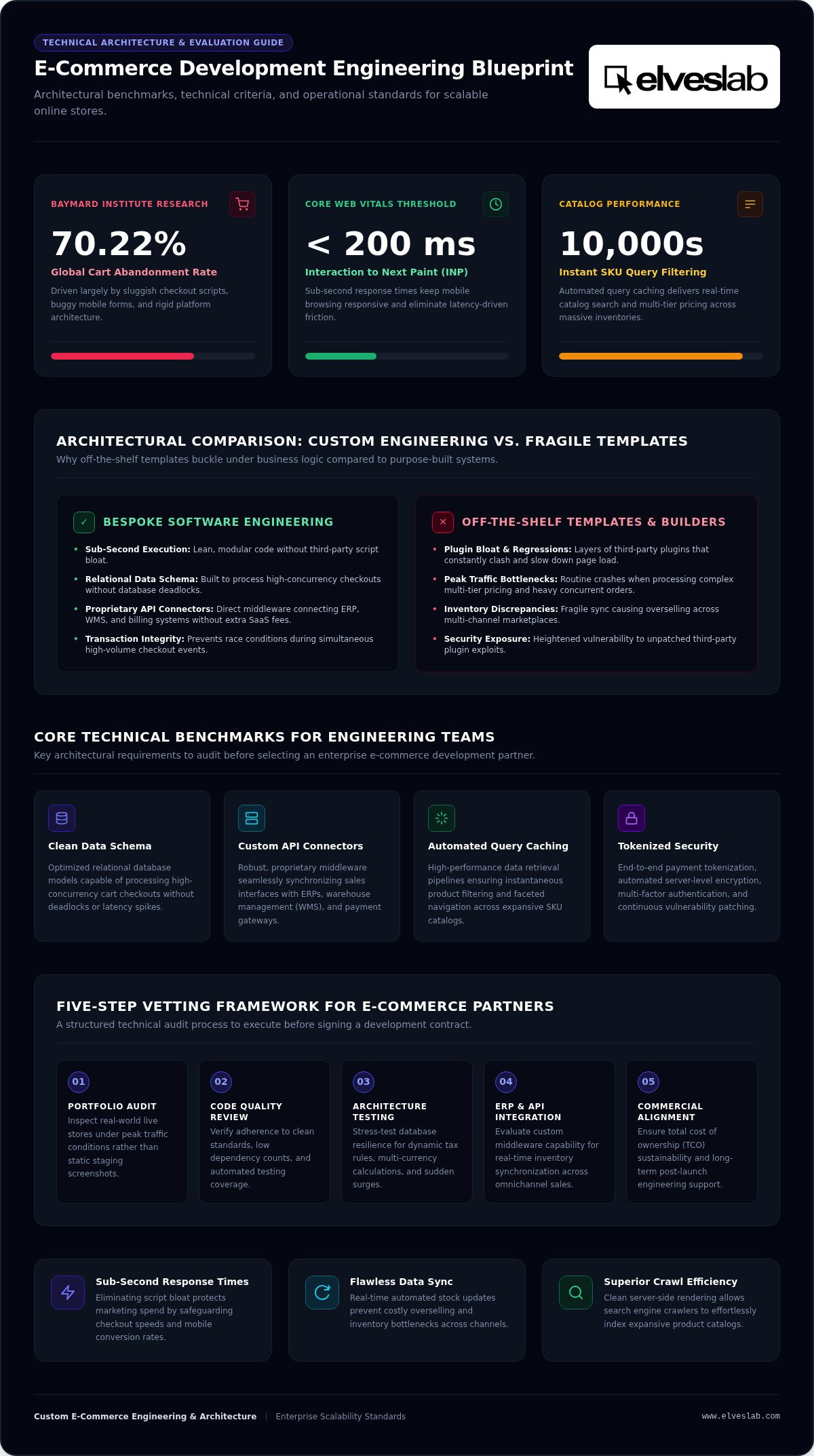
According to research by the Baymard Institute, the global cart abandonment rate sits at 70.22%, driven largely by sluggish checkout scripts, buggy mobile forms, and rigid architecture. It's frustrating to watch hard-won traffic vanish because an off-the-shelf template buckles under complex business logic, or worse, because a developer delivered messy code and vanished post-launch. When your store is the core engine of your business, hiring seasoned ecommerce development experts is the only way to safeguard your checkout, maintain sub-second speeds, and protect your margins.
This guide delivers a clear, actionable blueprint to evaluate, vet, and select the right engineering partner to build a scalable, high-converting store. We'll show you how to audit technical portfolios, stress-test architectural capabilities for multi-channel sales and ERP integrations, and secure a collaborative partner committed to your long-term commercial success.
Key Takeaways
- Learn how top-tier ecommerce development experts engineer sub-second transaction systems and robust checkout funnels that safeguard your margins.
- Identify the core technical capabilities required for modern retail, from seamless ERP integrations to clean custom architectures that eliminate plugin bloat.
- Compare agencies, freelance networks, and site builders across their true total cost of ownership to make a smart, sustainable business investment.
- Master a five-step vetting framework to thoroughly audit agency portfolios, review code standards, and test technical competencies before signing a contract.
- Discover the operational advantages of choosing bespoke software engineering over fragile off-the-shelf templates to support long-term commercial growth.
What Defines True E-Commerce Development Experts in 2026?
E-commerce is no longer about assembling an attractive digital storefront. True ecommerce development experts treat an online store as a mission-critical transaction engine where visual design strictly serves business logic. With rising customer acquisition costs across every channel, you can't afford checkout instability or sluggish responsiveness. A platform that stalls for two seconds during peak traffic quietly drains your marketing budget and alienates buyers.
Off-the-shelf templates might look polished in a staging demo. However, they routinely collapse when forced to handle complex multi-tier pricing, sprawling catalogs, and heavy concurrent orders. Solving these operational bottlenecks requires rigorous engineering discipline rather than surface-level theme customization.
The Evolution from Web Designers to Technical Architects
Visual styling captures attention, but robust software engineering completes the transaction. Modern development requires sophisticated database architecture capable of handling sudden traffic surges without creating inventory discrepancies or race conditions during payment processing.
Experienced technical teams architect systems that actively protect the integrity of your backend business rules. They ensure that dynamic currency conversions, regional tax rules, and complex stock allocations execute instantly. This stability eliminates system timeouts, safeguarding your margins against cart abandonment during high-volume sales events.
Core Architectural Competencies That Drive Commercial Performance
Commercial scalability hinges on how smoothly your storefront communicates with the rest of your business infrastructure. Skilled ecommerce development experts design custom APIs that link your sales interface directly with enterprise ERPs, warehouse management tools, and secure payment gateways. Understanding underlying e-commerce architecture and technologies enables engineers to deploy lean, modular code rather than relying on bloated third-party plugins that drag down performance.
This clean engineering foundation delivers measurable commercial advantages:
- Sub-second response times: Eliminating script bloat keeps Google Core Web Vitals, including Interaction to Next Paint (INP), well below the 200-millisecond threshold for responsive mobile browsing.
- Flawless data synchronisation: Real-time automated stock updates prevent overselling across omnichannel sales channels.
- Superior crawl efficiency: Clean server-side rendering and streamlined site structures allow search engines to index expansive product catalogs effortlessly.
Key Technical Criteria for Evaluating E-Commerce Development Agencies
Selecting an agency requires digging beneath the visual surface to inspect their core engineering standards. Generic tech stack lists tell you very little about how a partner handles complex data structures or unexpected traffic surges. True ecommerce development experts prove their capability through database query optimization, rock-solid server setups, and resilient codebases that protect your transaction pipelines.
Custom Code Quality and API Integration Capabilities
Bespoke engineering gives you uncompromised control over every step of your user journey and account workflows. While generic templates rely on layers of third-party plugins that constantly clash, clean custom development runs on lean, purpose-built logic. Eliminating bloated dependencies minimizes code regressions, slashes load times, and safeguards your store against unpatched third-party vulnerabilities. To see how custom engineering transforms store agility, review our strategic e-commerce development guide.
When you evaluate an engineering team, prioritize these core technical benchmarks:
- Clean data schema: Relational database design that processes high-concurrency cart checkouts without deadlocks.
- Proprietary API connectors: Robust middleware connecting inventory, warehousing, and billing platforms without third-party integration subscription fees.
- Automated query caching: Fast data retrieval that keeps catalog filtering instantaneous across tens of thousands of SKUs.
Checkout Security, Data Protection, and Compliance Standards
Payment security is non-negotiable. Modern ecommerce development experts design checkouts with end-to-end tokenization, ensuring raw credit card details never touch your server. Implementing automated server-level encryption, multi-factor authentication, and continuous vulnerability patching protects your brand against catastrophic data interception.
Your technical partner must follow proven security protocols, aligning your operational architecture with established FTC data protection guidelines. Enforcing script integrity controls stops unauthorized third-party trackers and malicious code injection right at the browser level.
Mobile Performance and Headless Commerce Readiness
Mobile conversion rates drop sharply when screens lag or input fields freeze. Leading engineering agencies design storefronts that pass Google Core Web Vitals comfortably, optimizing asset compression and server response headers to keep interactions smooth. For brands preparing for expansive multi-channel growth, building headless or composable architectures decouples frontend presentation layers from backend business logic. This separation allows you to launch mobile apps or regional storefronts without rebuilding core databases.
If you're looking for an experienced engineering team to audit your current infrastructure, explore how partnering with custom software development specialists can elevate your store's speed and security.
Choosing Your Development Model: Bespoke Agency vs. Freelancers vs. Site Builders
Every commercial path involves operational trade-offs. DIY site builders promise rapid setup, while freelance marketplaces highlight low upfront billing. Yet when transaction volume climbs, the total cost of ownership shifts dramatically. True ecommerce development experts evaluate not just launch velocity, but the long-term expense of maintenance, bug fixing, and custom workflow development.
Off-the-shelf site builders lock growing enterprises into rigid ecosystem rails. Recurring plugin subscriptions compound each month, yet essential customizations like custom wholesale logic or automated warehouse routing remain inaccessible. When systems fail or hit functional limitations, platform support offers generic documentation instead of engineering fixes.
Specialized Digital Agencies vs. Freelance Talent Networks
Relying on fragmented freelancers introduces severe operational vulnerability. Individual contractors may write capable code, but they rarely share accountability for the broader system architecture. If a solo developer becomes unavailable during a critical product drop, resolving checkout bugs falls squarely on your internal team.
In contrast, a dedicated engineering agency centralizes institutional knowledge. Cross-disciplinary teams unite frontend designers, backend engineers, and technical marketers under unified quality assurance protocols. For business owners evaluating potential partners, Forbes highlights key operational criteria for choosing the right e-commerce agency, emphasizing that in-house developer talent and clear post-launch accountability directly protect brand reliability.
Bespoke Custom Platforms vs. Rigid Template Solutions
Off-the-shelf templates force your operational workflows to conform to someone else's software constraints. In contrast, bespoke engineering builds software around your actual commercial requirements. Tailored architectures give you unrestricted flexibility over catalog structures, omnichannel customer data, and checkout funnels. You own your code, eliminate endless plugin licensing overhead, and avoid performance degradation from third-party bloat.
Selecting the right development structure directly influences long-term commercial performance:
- Site Builders: Low initial barrier to entry, but high long-term friction caused by restrictive data schemas and compounding app subscription fees.
- Freelance Networks: Flexible for isolated bug fixes, yet plagued by inconsistent code standards and absent post-deployment accountability.
- Bespoke Development Agencies: Unified technical governance delivering dedicated ecommerce development experts, custom database control, and continuous architectural scalability.
To understand how custom platforms fuel distinct brand presentation and frictionless conversion paths, read our detailed analysis on custom web design strategy.
A Five-Step Vetting Framework to Hire the Right E-Commerce Partner
Hiring the wrong agency drains capital and stalls commercial momentum. Beautiful design mockups are easy to assemble, but true retail performance happens in the code. To secure genuine ecommerce development experts, you need a disciplined evaluation framework that inspects operational stability, source code standards, and technical accountability before signing any contracts.
Step 1 & 2: Auditing Portfolios, Case Studies, and Technical Scope
Start by testing live client storefronts under real-world conditions. Don't settle for static portfolio screenshots. Open mobile browsers, add multi-variant products to carts, and navigate checkout funnels to evaluate responsiveness firsthand. Ask prospective partners for documented case studies demonstrating measurable conversion improvements and transaction stability during traffic spikes.
Next, insist on a dedicated technical discovery phase. Capable engineers never provide fixed project estimates based on high-level verbal briefs. They run structured workshops to map your data architecture, catalog hierarchies, and third-party API dependencies. Require a comprehensive functional specification document before committing to an engineering build. Clear scope prevents costly mid-project revisions.
Step 3, 4 & 5: Architecture, Communication, and Post-Launch Support
Step three centers on infrastructure integrity and intellectual property. Confirm in writing that your business retains 100% ownership of custom source code and database schemas upon delivery. Verify that the team uses modern Git version control, automated testing routines, and segregated staging environments. Reviewing standard engineering practices in our guide to web application development provides a solid baseline for assessing an agency's technical toolchain.
Step four defines governance and team communication. Establish a single dedicated point of contact, agreed sprint schedules, and milestone demonstrations. Avoid teams that operate behind opaque ticketing portals without direct access to technical leads.
Finally, step five secures post-launch operational continuity. An online store is a living engine that demands proactive server monitoring, routine database optimization, and rapid vulnerability patching. Contractual clarity on ongoing technical support protects your revenue pipeline against unforeseen outages.
Following this structured sequence ensures you engage ecommerce development experts who operate as genuine commercial partners. Ready to architect a resilient, high-converting digital storefront? Partner with our engineering team to build a tailored platform designed for long-term growth.
Why Partner with Elves Lab for Custom E-Commerce Engineering
Engineering a high-performing digital storefront requires a partner who looks beyond transactional tasks to understand your broader commercial vision. Since 2000, Elves Lab has operated as a dedicated digital agency, accumulating over two decades of continuous bespoke web and software engineering experience. Rather than recycling off-the-shelf templates, our team builds custom platforms from scratch, shaping digital infrastructure around your precise operational requirements.
Managing an e-commerce platform becomes chaotic when you're caught between disjointed hosting providers, freelance coders, and marketing vendors. We eliminate that friction by providing a unified digital ecosystem where software development, managed infrastructure, and digital marketing work seamlessly together under one roof.
Over Two Decades of Bespoke Web and Software Engineering
We believe your software should adapt to your operational workflows, never the reverse. Off-the-shelf templates frequently force businesses into clunky administrative workarounds. Our team architects custom backend logic, clean database schemas, and tailored administrative interfaces built to process heavy transactional volume reliably.
Every store we build is powered by our proprietary custom Content Management System (CMS). This lightweight backend allows your internal operations team to update catalogs, adjust pricing rules, and manage customer accounts quickly without wading through confusing plugin settings or risking accidental site breaks.
Full-Stack Integration: Custom CMS, Managed Hosting, and SEO
True scalability happens when technical infrastructure aligns directly with organic acquisition and engaging merchandising. As seasoned ecommerce development experts, we don't just write functional code. We connect every layer of your digital presence into a coherent growth engine designed to attract, convert, and retain high-value shoppers.
Our integrated capabilities deliver strategic advantages across your entire operation:
- High-performance web hosting: Optimized server architectures engineered for continuous uptime, rapid query execution, and resilient checkout stability.
- Search-first architecture: Deep structural alignment with our proven ecommerce SEO framework to secure indexation and visibility across traditional and AI-driven search discovery.
- Dynamic creative assets: Modern AI video generation capabilities that transform standard product catalogs into dynamic visual assets for social media marketing and promotional campaigns.
When you're ready to engineer a stable, high-converting storefront built for the future, connect directly with the technical specialists at Elves Lab to bring your platform to life.
Build Your Next-Generation E-Commerce Engine Today
Selecting the right technical partner transforms your online store from a fragile digital storefront into an agile commercial powerhouse. By focusing on clean database architecture, robust API integrations, and total code ownership, you protect your business against checkout downtime and escalating subscription fees. Moving away from rigid templates ensures your transaction pipelines remain lightning-fast as your order volumes multiply.
Choosing dedicated ecommerce development experts ensures your platform scales seamlessly alongside your business goals. Backed by over two decades of bespoke software engineering since 2000, Elves Lab builds custom platforms engineered entirely from scratch. Supported by our in-house CMS, managed web hosting, organic SEO, and AI video generation, our team is ready to elevate your brand. Partner with Elves Lab for custom e-commerce engineering and take complete command of your digital growth.
Frequently Asked Questions
How do I know if my business needs custom e-commerce development instead of a template?
You need custom development when off-the-shelf templates restrict your operational workflows or degrade site speed. If your store requires complex wholesale pricing tiers, multi-warehouse routing, or unique checkout sequences, generic plugins often fail. Custom architectures eliminate third-party code conflicts, allowing your technical systems to scale alongside growing inventory without performance bottlenecks.
How long does a bespoke e-commerce development project typically take from start to finish?
Project timelines depend entirely on technical complexity, catalog size, and integration requirements. A focused build with standard operational workflows generally requires several weeks of engineering, while complex enterprise platforms involving bespoke database schemas and legacy ERP middleware take several months. Experienced ecommerce development experts determine exact production schedules during the initial functional discovery phase.
What security measures should professional e-commerce development experts implement?
Professional engineers implement tokenized checkout gateways to ensure sensitive payment data never touches your server. They enforce automated server-level encryption, multi-factor authentication, and strict script integrity controls to block client-side data skimming. Continuous security patching and isolated staging environments safeguard customer records against unauthorized access.
Can custom e-commerce platforms integrate with our existing ERP and inventory software?
Yes, custom platforms excel at direct system synchronization through purpose-built APIs. Skilled engineers build lightweight middleware that connects your online storefront directly with your enterprise resource planning, point-of-sale, and warehouse management software. This direct data pipeline automates stock updates and order processing without recurring connector subscription fees.
What happens to our source code and platform data after the store is launched?
You retain full legal ownership of your bespoke source code, database architectures, and commercial customer records upon project completion. Reputable engineering agencies hand over documented Git repositories and necessary administrative credentials during deployment. You are never locked into proprietary vendor frameworks that hold your digital assets hostage.
How does bespoke e-commerce code improve search engine rankings and conversion rates?
Clean bespoke code eliminates unnecessary JavaScript libraries and CSS bloat that slow down page rendering. Fast server response times keep Google Core Web Vitals optimized, directly enhancing mobile search visibility and indexing efficiency. Faster page responsiveness creates frictionless browsing, keeping shoppers engaged and driving higher checkout completion rates.
What post-launch support and hosting maintenance does Elves Lab provide?
Elves Lab provides managed web hosting and proactive technical maintenance to ensure sustained uptime and optimal platform speed. Our team monitors server health, executes core security patches, and handles ongoing technical adjustments during standard business hours. We partner with brands for the long haul, maintaining operational stability as traffic and transactional volumes expand.
Disclaimer
AI-Generated Content Disclaimer
The articles, blog posts, and informational content published on this website may be generated or assisted by artificial intelligence (AI) tools for search engine optimisation (SEO), content discovery, and informational purposes.
While reasonable efforts are made to ensure the content is relevant and useful, the information provided may not always be accurate, complete, current, or applicable to your specific circumstances. The views, opinions, statements, recommendations, or interpretations expressed in these articles are generated based on publicly available information and do not necessarily reflect the views, opinions, positions, policies, or professional advice of our company, its management, employees, partners, or affiliates.
The content should not be construed as legal, financial, medical, technical, professional, or other specialised advice. Readers are encouraged to independently verify any information and seek professional consultation where appropriate before making decisions based on the content provided.
Our company shall not be held liable for any loss, damage, claim, or consequence arising directly or indirectly from the use of, reliance upon, or interpretation of any AI-generated content published on this website.
By accessing and using this website, you acknowledge and accept that certain content may be generated or assisted by AI technologies and is provided on an "as is" basis for informational and SEO purposes only.