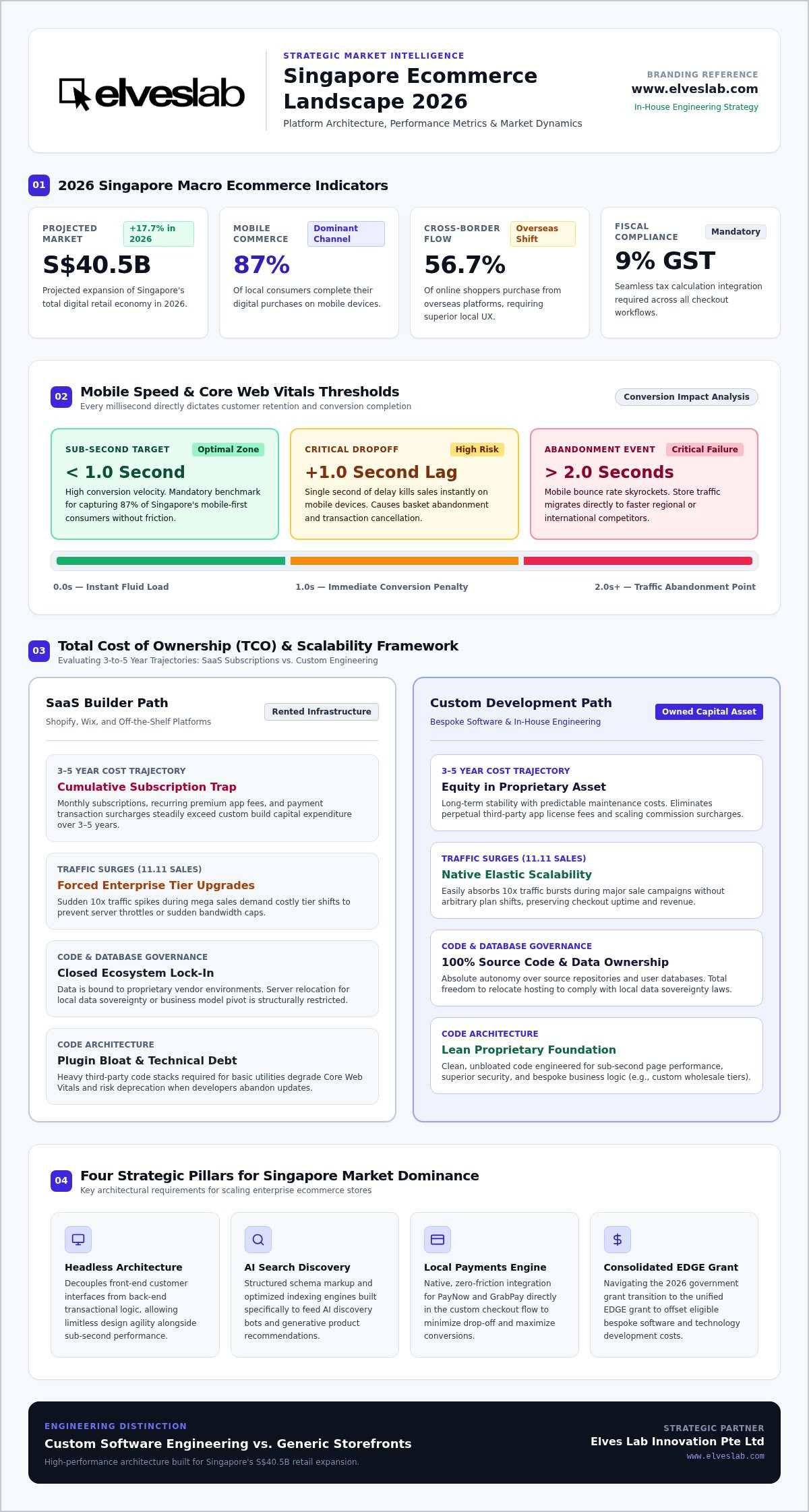
Singapore's ecommerce market is projected to expand by 17.7% in 2026 to reach a staggering S$40.5 billion. Yet, nearly 87% of these local consumers are completing their purchases on mobile devices, where a single second of lag can kill a sale instantly. You know that a generic template isn't going to cut it anymore. It's frustrating to feel stuck between the fear of high development costs and the confusion of choosing between Shopify, WooCommerce, or a bespoke build that actually scales.
Finding the right ecommerce website developer Singapore businesses rely on means looking for a partner who understands that your store is a high-performance asset, not just a digital brochure. We agree that you shouldn't have to sacrifice speed for security or SEO for aesthetics. This strategic guide promises to help you master the selection process, ensuring your store is fast, secure, and conversion-focused. We'll preview the critical 2026 platform trends, local payment integrations like PayNow, and how to navigate the transition to the new EDGE grant to maximize your ROI. It's time to build a store that doesn't just look good but dominates the local market.
Key Takeaways
- Understand why generic templates are failing in 2026 and why a specialized approach is required to capture Singapore's S$40.5 billion ecommerce market.
- Learn to analyze the long-term total cost of ownership between SaaS builders and custom development to avoid hidden subscription traps.
- Discover the essential criteria for selecting an ecommerce website developer Singapore, focusing on in-house engineering and bespoke software capabilities.
- Navigate the 2026 government grant landscape, including the critical shift to the consolidated EDGE grant for offsetting development costs.
- Identify the technical requirements for high-performance stores, from sub-second mobile speeds to seamless PayNow and GrabPay integrations.
The 2026 Ecommerce Landscape: Why You Need a Specialized Developer
Singapore's digital market has shifted from simple storefronts to integrated business ecosystems. Your online store in 2026 isn't just a website; it's the heart of your operations. It connects inventory, local payment gateways, and customer data in real time. Managing this complexity requires an ecommerce website developer Singapore businesses trust to understand more than basic design. They must master modern e-commerce architecture and models to keep your system agile as technology evolves.
We're seeing a massive move toward headless commerce and AI-driven personalization. This architecture separates the front-end user experience from the back-end logic, giving you total creative freedom without compromising performance. Core Web Vitals are no longer just a "nice-to-have" metric; they're a survival requirement. If your site takes more than two seconds to load on a mobile device, your bounce rate will skyrocket. A specialized developer builds for these technical shifts from day one, ensuring your store is ready for the future.
Your developer should act as a strategic growth partner, not just a code writer. They need to look at your business holistically, from how you handle 9% GST compliance to how you manage cross-border shipping. In a market where 56.7% of online shoppers purchase from overseas, your site needs to be faster and more intuitive than global competitors. This level of precision requires a team that understands the local landscape inside and out.
Beyond the Template: The Need for Customization
Off-the-shelf templates often come with "feature bloat" that slows down your site. They struggle to handle unique business logic, like complex product variations or custom loyalty programs. Proprietary code offers a cleaner, more secure foundation. It makes long-term maintenance easier because you aren't reliant on third-party plugin developers who might stop providing updates. Custom ecommerce development serves as a critical competitive advantage in the Singapore market by allowing your brand to offer features that generic competitors simply can't replicate.
Evolving Search Intent and AI Discovery
Search is changing rapidly. Customers aren't just using Google; they're using AI-powered discovery tools to find products. Your site architecture must be readable by these bots to earn a spot in AI-generated recommendations. This requires a deep understanding of ecommerce seo singapore strategies that go beyond simple keywords. A specialized ecommerce website developer Singapore professional ensures your schema markup and site speed are optimized for both traditional search and the new era of AI discovery.
Custom Ecommerce Development vs. SaaS Builders
SaaS builders like Shopify or Wix offer a quick start. It's tempting for a new business. But as you scale, the Total Cost of Ownership (TCO) changes significantly. Over a 3 to 5 year period, those monthly subscriptions, premium app fees, and transaction surcharges often exceed the cost of a custom build. Choosing an ecommerce website developer Singapore businesses rely on for custom work means you're investing in an asset you actually own. You aren't just renting space on a closed platform where your data is tied to their specific rules.
Scalability is the real test for any growing brand. When your traffic grows 10x during a major sale like 11.11, a bespoke system handles the surge without forcing you into a more expensive "Enterprise" tier. You own the source code and the database. This eliminates the risk of being locked into a provider's proprietary ecosystem. If you need to move servers to comply with local data sovereignty or change your business model, you have the absolute freedom to do so.
The Bespoke Advantage for Scaling SMEs
Custom software development allows you to build features that simply don't exist in a standard plugin library. You might need complex wholesale pricing structures or unique local logistics integrations that standard platforms can't handle. Optimizing your checkout flow for the Singaporean market is essential for success. Integrating PayNow or GrabPay directly into a custom flow reduces friction and significantly boosts your conversion rates. Investing in custom ecommerce web design ensures your brand stands out in a crowded market of identical templates. It's about creating a shopping journey that feels local, fast, and seamless.
Performance and Technical Debt
SaaS platforms frequently rely on multiple third-party plugins for basic functions like SEO or reviews. These plugins often carry heavy, unnecessary code that slows your site down. This "bloat" directly hurts your search rankings and frustrates the 87% of Singaporean shoppers who use mobile devices. Lean, custom-coded solutions prioritize speed and security from the first line of code. Technical debt accumulates in template-based ecommerce sites as layers of conflicting plugins and outdated themes make future updates nearly impossible without breaking the entire storefront. If you want a partner to build a high-performance store, see how we build bespoke solutions. You can also explore co-funding through the Productivity Solutions Grant (PSG) to help offset these costs while the current framework remains active.
Essential Criteria for Evaluating a Developer in Singapore
Your choice of developer defines your store's ultimate ceiling. In a market where consumers expect perfection, you can't afford a partner who simply installs a theme and calls it a day. A top-tier ecommerce website developer Singapore professional must demonstrate a deep track record in bespoke software. They should build systems from the ground up to ensure every line of code serves your business goals. Always ask if the development is handled in-house. Outsourcing often leads to broken timelines and technical gaps that become apparent only after you've paid the deposit.
A truly capable partner offers full-stack expertise. This means they manage everything from complex backend logic to professional web design Singapore brands use to build trust. Beyond the initial build, your developer must provide a reliable web hosting infrastructure. Without high-speed local servers and proactive post-launch support, your store will struggle to maintain the sub-second load times required to rank in 2026. Security updates and performance monitoring shouldn't be afterthoughts; they're the foundation of a scalable business.
Technical Proficiency and Integration Skills
Success in the local market depends on how well your store plays with others. Your developer needs proven experience integrating local payment gateways like PayNow and GrabPay to reduce checkout friction. They must also connect your storefront to logistics APIs, CRMs, and ERP systems without creating data silos. Understanding web application development Singapore standards ensures your site remains compliant with local regulations while delivering a seamless user experience. Understanding Singapore's eCommerce market landscape is vital for any agency building high-stakes transactional systems that need to handle thousands of concurrent users.
Strategic Marketing and AI Capabilities
A great ecommerce website developer Singapore team looks beyond the code to your actual sales funnel. They should offer integrated SEO and social media marketing to ensure people actually find your store. In 2026, static images aren't enough to capture attention. Look for developers who can implement cutting-edge features like AI video generation Singapore businesses are using to create dynamic product demonstrations. This forward-thinking approach ensures your store isn't just a digital catalog, but an active participant in your customer's buying journey. A developer who understands the full marketing funnel will build a site that converts traffic into loyal, repeat customers.
Navigating Costs and Government Grants in 2026
Investing in a professional ecommerce website developer Singapore businesses trust is a strategic decision that requires careful budgeting. Costs are never one-size-fits-all. A bespoke platform with complex ERP integrations and custom business logic requires a different investment level than a streamlined boutique store. However, the Singapore government continues to provide robust support to help local businesses stay competitive. We're currently in a pivotal transition period for digital funding. The long-standing Productivity Solutions Grant (PSG) and Enterprise Development Grant (EDG) are being consolidated into the unified EDGE Grant, which officially takes effect on 30 September 2026.
Applying for these grants requires precision. Your project scope must clearly demonstrate how the new system improves your business productivity or helps you expand into new markets. It's vital to remember that you can't make any payments or deposits to your developer before your grant application is submitted and approved. Working with a partner who understands these timelines ensures you don't miss out on co-funding opportunities that can significantly offset your initial capital outlay.
Breakdown of Ecommerce Development Costs
Several factors influence your final quote. Complexity is the biggest driver. If you need unique feature sets, such as AI-driven product recommendations or complex multi-currency checkout flows, the engineering hours will increase. Don't be swayed by the cheapest quote. Low-cost providers often cut corners on security and mobile optimization, leading to higher long-term costs in technical debt and lost sales. You must also budget for secure web hosting and ongoing maintenance. These ensure your store remains compliant with 9% GST display rules and PDPA data protection standards, which can carry heavy penalties for non-compliance.
Maximizing Your Digital Transformation Budget
Aligning your project with national digital initiatives is the best way to scale sustainably. For those pursuing e-commerce development Singapore projects, timing is everything. If you submit your application before 29 September 2026, you can still access PSG support for up to 50% of eligible costs, capped at S$30,000. Projects submitted from 30 September onwards under the new EDGE Grant may qualify for up to 70% support for SMEs, with a significantly higher total grant cap of S$100,000. We've spent over two decades helping clients navigate these frameworks to build high-performance stores. If you want to maximize your ROI, let's discuss your grant eligibility and project scope.
Why Elves Lab is the Strategic Partner for Your Ecommerce Success
Choosing an ecommerce website developer Singapore businesses have relied on for over 25 years means choosing stability. Since 2000, Elves Lab Pte Ltd has navigated every major shift in the digital economy. We don't believe in the limitations of off-the-shelf templates. Instead, we focus on building bespoke software that adapts to your specific needs. This commitment ensures your store remains fast, secure, and ready for the 17.7% market growth projected for 2026. We aren't just here to launch a site; we're here to build a long-term partnership that supports your business as it scales from a local boutique to a regional powerhouse.
Our approach is truly end-to-end. We handle everything from the initial backend architecture to high-speed local hosting and integrated SEO. In 2026, standing out requires more than just a functional cart. That's why we incorporate cutting-edge tools like AI video generation to make your product pages more engaging. By combining technical precision with creative energy, we ensure your store captures attention and converts it into revenue. You get a single point of contact for your entire digital ecosystem as your ecommerce website developer Singapore partner, removing the frustration of managing multiple vendors.
The Elves Lab Pte Ltd Custom Development Process
Our process begins with deep discovery and strategy. We align the site's architecture with your specific business goals and unique logic. Our team then moves into bespoke design and coding, creating a unique digital footprint that avoids the cookie-cutter look of competitors. Every project undergoes rigorous testing before deployment on our secure, Singapore-based infrastructure. We prioritize PDPA compliance and sub-second load times, ensuring your customers enjoy a safe and seamless shopping experience from day one. This methodical approach guarantees that every feature we build adds direct value to your bottom line.
Ready to Scale Your Online Business?
Success in the competitive Singaporean market requires a proactive strategy. We integrate SEO and social media marketing into the development phase so you can drive traffic immediately after launch. Our local, Singapore-based team provides personalized support, ensuring you're never left talking to a bot when you need help. We're ready to help you navigate the transition to the new EDGE grant and build a store that dominates your niche. Consult with Elves Lab Pte Ltd for your bespoke ecommerce solution today!
Future-Proof Your Digital Growth in 2026
The ecommerce landscape in Singapore is moving faster than ever. You now know that choosing a specialized ecommerce website developer Singapore businesses trust is the difference between a static storefront and a scalable engine. Success in 2026 requires moving beyond restrictive templates to embrace bespoke software that prioritizes mobile speed and seamless local payment integrations. By leveraging the latest government grants and focusing on custom-built architecture, you can secure your brand's data and avoid the hidden costs of SaaS platforms.
Elves Lab has been at the forefront of this evolution since 2000. Our local, Singapore-based in-house team specializes in bespoke software and CMS solutions designed to handle high-traffic surges and complex business logic. We don't just build websites; we create high-performance assets that grow with you. Our deep heritage in the local market ensures your store is compliant, secure, and optimized for maximum ROI.
Ready to transform your online presence? Get a Custom Ecommerce Quote from Elves Lab and let's build something exceptional together. Your journey toward a conversion-focused, secure, and fully optimized online store starts with a single strategic choice. We're excited to help you dominate the digital marketplace.
Frequently Asked Questions
How much does it cost to hire an ecommerce website developer in Singapore in 2026?
Ecommerce development costs depend on the complexity of your business logic and the depth of third-party integrations. For 2026, you must also account for the statutory 9% GST on all local services. While basic setups are cheaper, a custom build that handles high traffic and complex inventory requires a larger initial investment. We recommend focusing on the total cost of ownership over five years rather than just the initial quote.
Can I use government grants like PSG or EDG for custom ecommerce development?
Yes, you can use government support, but the framework is changing in late 2026. The PSG and EDG grants are merging into the unified EDGE grant starting 30 September 2026. If you apply before this date, you can still access up to 50% co-funding under legacy schemes. After the cutover, the EDGE grant offers up to 70% support for SMEs, capped at S$100,000 per financial year for digital transformation.
How long does it typically take to build a custom ecommerce website?
A custom ecommerce build typically takes between 12 to 24 weeks depending on the project's scope. This timeline includes discovery, bespoke design, backend development, and rigorous security testing. Simple template-based sites are faster but often lack the scalability needed for long-term growth. We prioritize a methodical process to ensure your store is fully optimized and PDPA-compliant before it goes live to the Singaporean public.
Should I choose Shopify, WooCommerce, or a custom-built platform?
Choosing between Shopify, WooCommerce, or a custom platform depends on your need for data ownership and scalability. SaaS platforms offer convenience but charge recurring fees and transaction surcharges that eat into your margins. A custom-built platform from an ecommerce website developer Singapore professional gives you total intellectual property ownership. This approach eliminates technical debt and allows you to build unique features that aren't possible with standard plugins.
What local payment gateways should my Singapore ecommerce site support?
Your store should support PayNow, GrabPay, and major credit cards to meet local consumer expectations. PayNow QR generation is particularly important since it accounts for a significant portion of real-time domestic transactions in Singapore. Integrating these gateways directly into a custom checkout flow reduces friction. It's also vital to ensure your system handles the 9% GST inclusive price display requirement mandated by IRAS for all customer-facing transactions.
Do I need separate SEO services if I hire an ecommerce developer?
You don't necessarily need a separate agency if your developer provides integrated search engine optimization. An ecommerce website developer Singapore team like Elves Lab builds SEO into the site's architecture from the first line of code. This includes optimizing for AI discovery and traditional search engines simultaneously. Having your development and SEO teams under one roof ensures that technical updates don't break your rankings or slow down your page load speeds.
What is the difference between a web designer and an ecommerce developer?
A web designer focuses on the visual aesthetics and user interface, while an ecommerce developer builds the functional logic and database architecture. In the context of online retail, you need a partner who can do both. The developer ensures your shopping cart, payment gateway, and inventory sync work flawlessly behind the scenes. Without strong development, a beautiful design won't be able to handle complex transactions or secure customer data according to PDPA standards.
How do I ensure my ecommerce site is mobile-responsive and fast?
Ensuring your site is fast requires lean, custom code and reliable local hosting. Since over 80% of Singaporean shoppers use mobile devices, we prioritize a mobile-first architecture that eliminates heavy plugin bloat. Using high-performance servers located in Singapore reduces latency and improves Core Web Vitals. We also implement image optimization and lazy loading to ensure your product pages load in under two seconds, which is critical for maintaining high conversion rates.
Disclaimer
AI-Generated Content Disclaimer
The articles, blog posts, and informational content published on this website may be generated or assisted by artificial intelligence (AI) tools for search engine optimisation (SEO), content discovery, and informational purposes.
While reasonable efforts are made to ensure the content is relevant and useful, the information provided may not always be accurate, complete, current, or applicable to your specific circumstances. The views, opinions, statements, recommendations, or interpretations expressed in these articles are generated based on publicly available information and do not necessarily reflect the views, opinions, positions, policies, or professional advice of our company, its management, employees, partners, or affiliates.
The content should not be construed as legal, financial, medical, technical, professional, or other specialised advice. Readers are encouraged to independently verify any information and seek professional consultation where appropriate before making decisions based on the content provided.
Our company shall not be held liable for any loss, damage, claim, or consequence arising directly or indirectly from the use of, reliance upon, or interpretation of any AI-generated content published on this website.
By accessing and using this website, you acknowledge and accept that certain content may be generated or assisted by AI technologies and is provided on an "as is" basis for informational and SEO purposes only.