
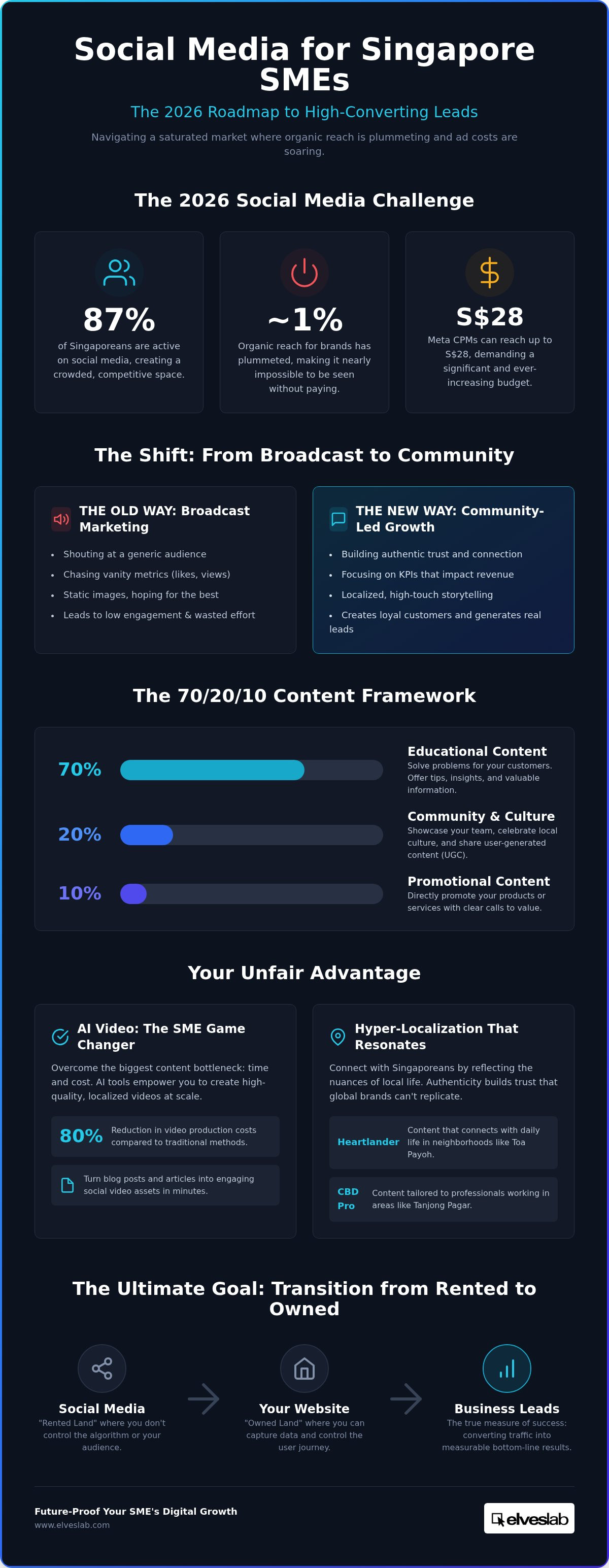
Did you know that while 87% of Singaporeans are active on social media in 2026, organic reach for brands has dropped to as low as 1%? It's a tough reality for local business owners refining their social media strategy for Singapore SMEs. You've likely felt the sting of rising ad costs, with Meta CPMs reaching up to S$28 and TikTok requiring a constant stream of high-quality video just to stay relevant. It's exhausting to maintain a presence that feels fragmented between your social apps and your website.
We understand that you want your digital marketing to work harder for you. This guide will show you how to transform your social presence into a high-converting lead engine using localized storytelling and AI-driven content. You'll learn how to bridge the gap between a simple like and a confirmed sale. We'll provide a clear 2026 roadmap to help you integrate social traffic with your web ecosystem while maximizing available grants like the PSG for AI-enabled solutions.
Key Takeaways
- Master the shift from broadcast marketing to community-led growth to build authentic trust in a saturated 2026 digital market.
- Implement a data-backed social media strategy for Singapore SMEs using the 70/20/10 rule to balance education, community engagement, and promotion.
- Leverage AI video generation to overcome content bottlenecks and produce high-quality, localized storytelling that resonates with Singaporean audiences.
- Transition followers from "rented land" on social apps to your own custom website to ensure your traffic actually converts into measurable business leads.
- Define three core KPIs that directly impact your bottom line instead of chasing vanity metrics like likes or follower counts.
The Singapore market in 2026 is louder than ever. With approximately 87% of the population active on social platforms, the digital space is beyond crowded. For local business owners, simply "being online" is no longer a competitive advantage. You aren't just competing with the shop next door; you're fighting for a few seconds of a Singaporean's attention against global creators and massive corporations. This saturation has forced a fundamental shift from "broadcast marketing," where brands shout at a generic audience, toward "community-led growth."
A successful social media strategy for Singapore SMEs now relies on balancing high-tech efficiency with high-touch storytelling. We've entered the era of "Authentic AI." This means using tools like AI video generation to handle the grueling content production cycle while keeping the heart of the message strictly local. TikTok has officially surpassed Instagram as the primary platform for Singaporeans under 30. Meanwhile, LinkedIn has emerged as the highest-converting space for B2B businesses looking for serious decision-makers. Understanding Corporate Social Media Explained in this localized context is the first step to standing out.
Why Traditional Posting No Longer Works
The old playbook of posting a static image and hoping for the best is dead. Organic reach on legacy platforms has plummeted to between 1% and 8%. Algorithms have shifted from "who you follow" to "what you're interested in." Your content is now shown to people based on their behavior, not their loyalty to your page. Many SMEs fall into the "viral trap" by chasing trends that don't result in revenue. If a video gets 50,000 views but zero enquiries, it's a wasted effort. In 2026, interest-based feeds demand content that solves a specific problem or entertains a specific niche.
The Role of Localized Context in 2026
Singaporeans have a very low tolerance for forced, "cringe" marketing. To win, your content must reflect the nuances of local life. There's a massive difference between targeting a "Heartlander" in Toa Payoh and a "CBD Professional" in Tanjong Pagar. Nuance matters. Using Singlish or local cultural markers should feel like a natural conversation at a hawker centre, not a marketing gimmick. Trust is built through micro-influencers who have genuine authority in niche Singaporean communities. By focusing on localized storytelling, you ensure your social media strategy for Singapore SMEs feels authentic to the person scrolling through their feed during their morning MRT commute.
Building a Localized Content Pillar with AI Efficiency
Developing a content framework shouldn't feel like a guessing game. For your social media strategy for Singapore SMEs to succeed, you need a structure that balances value with sales. We advocate for the 70/20/10 rule. 70% of your posts should be educational, offering tips or insights that solve problems for your local customers. 20% should focus on community, celebrating local culture or your team. The final 10% is for promotion. This mix ensures you aren't just another brand shouting "buy now" in a crowded feed.
Capturing attention in 2026 requires "snackable" content. You have less than three seconds to stop the scroll. This is where high-impact visuals meet localized storytelling. If your content doesn't feel relevant to someone living in Jurong or working in Raffles Place within those first few seconds, they'll swipe past. This framework is a core part of Singapore's SME digitalisation framework, which encourages businesses to adopt smarter, more efficient digital workflows.
AI Video Generation: The SME Game Changer
The biggest bottleneck for local businesses is time. Creating high-quality video usually requires expensive gear and days of editing. However, AI video generation Singapore has changed the math. You can reduce production costs by 80% by turning blog posts into social video assets in minutes. You maintain your brand voice while AI handles the heavy lifting. This allows you to keep your TikTok feeds active without a film crew.
Storytelling That Converts
Humanizing your brand builds trust. Show the people behind your SME. Whether it's your warehouse team packing orders or a chat with the founder, these moments resonate. Pair this with User-Generated Content (UGC). When a local customer shares their experience, it acts as the ultimate social proof. Write "sticky" captions that encourage saves. A solid social media strategy for Singapore SMEs ensures every post serves a purpose. If you need help, exploring bespoke social media services can align your content with your goals.
Choosing the right channel is half the battle won. In 2026, with organic reach for brand pages hovering between 1% and 8%, a "post and pray" approach is a recipe for wasted time. Your social media strategy for Singapore SMEs needs a hybrid "Boost" model. This means using small, targeted ad spends to push your best-performing content to new audiences. To see meaningful results, a practical minimum digital marketing budget for a local SME is now around S$1,500 to S$2,000 per month.
Don't write off Facebook just yet. While younger users have migrated, 72.7% of Singapore's internet users still maintain active Facebook accounts. It remains a powerhouse for reaching older demographics and specific interest groups. However, the focus must shift from vanity metrics to the bottom line. Move beyond counting likes and start tracking your Cost Per Lead (CPL). For service-based businesses in Singapore, a healthy CPL on Meta platforms typically ranges from S$8 to S$45. If your current ads are costing more, it's time to refine your targeting or your offer.
TikTok and Reels: Capturing the Gen Z and Millennial Market
TikTok has officially overtaken Instagram as the leading platform for Singaporeans under 30. The golden rule here is to entertain first and sell second. Users don't want to see polished commercials; they want authentic, high-energy content. Success on these platforms involves:
- Using trending local sounds and challenges to appear in the "For You" feed.
- Leveraging TikTok Shop for direct e-commerce conversion without leaving the app.
- Creating vertical videos that feel like they were shot by a friend, not a corporation.
LinkedIn: The B2B Powerhouse for SG Services
For B2B businesses, LinkedIn has emerged as the highest-converting platform in the Singapore market. It's no longer just a site for resumes; it's a hub for thought leadership. SME founders should use their personal profiles to share industry insights, which often see higher engagement than corporate pages. LinkedIn Ads allow you to target decision-makers by job title or specific Singaporean industries with incredible precision. While the average Cost Per Click (CPC) sits around S$2.00, the high intent of the audience often justifies the investment. It's also an essential tool for building a corporate brand that attracts top local talent in a competitive hiring landscape.
Many local businesses make the mistake of treating social platforms as the final destination. It's a dangerous game. Think of Facebook, TikTok, and Instagram as "rented land." You don't own the audience; the platform does. If an algorithm shifts or safety regulations tighten, your access to those customers could vanish overnight. A robust social media strategy for Singapore SMEs uses these apps as the "hook" to lead users back to a platform you actually control: your website.
This is where custom web design Singapore becomes your most valuable asset. A generic template often fails to convert social traffic because it lacks "ad scent." If a user clicks a vibrant, high-energy TikTok ad and lands on a slow, corporate-looking site, they'll bounce immediately. Your website needs to be the "closer" that turns that fleeting interest into a tangible lead or sale.
Creating High-Conversion Landing Pages
Success lies in the details of the user journey. Since 90% of your social traffic comes from smartphones, your site must be mobile-first. It's not just about fitting the screen; it's about the thumb-friendly experience. Using a bespoke CMS allows you to build specific landing pages for different social campaigns. This helps you track exactly which platforms are driving the highest quality leads. When your website experience mirrors the energy of your social posts, conversion rates climb.
Social Media and SEO Synergy
While social media doesn't directly boost your social media strategy for Singapore SMEs in terms of raw backlink power, the indirect benefits are massive. High engagement and shares drive significant traffic, which signals to search engines that your content is authoritative. This visibility helps improve your Google ranking Singapore over time. You can also use social listening to see what questions your local audience is asking. These insights become the perfect topics for your SEO blog strategy, creating a loop where social and search work together.
Building a cohesive brand across all touchpoints ensures your SME looks professional and reliable. If you're ready to stop relying on rented land, build a high-converting website that closes the deals your social media starts.
Implementation Roadmap: From Strategy to Execution
Strategy is only as good as its execution. To turn these insights into a functioning lead engine, you need a structured approach. Transforming your social media strategy for Singapore SMEs from a plan into a reality requires a 90-day commitment to consistency. Don't try to change everything overnight. Focus on building a sustainable system that integrates your social content with your bespoke web infrastructure.
- Step 1: Audit and Analyze. Examine your current digital footprint. Identify which platforms currently drive traffic and where your competitors are gaining ground.
- Step 2: Define Bottom-Line KPIs. Forget likes and follows. Focus on three core metrics: Cost Per Lead (CPL), website conversion rate, and engagement quality from your target Singaporean demographic.
- Step 3: Build Your Infrastructure. Ensure your custom website and CMS are ready to receive traffic. Set up tracking pixels and CRM integration so you know exactly where every lead originated.
- Step 4: Execute the 90-Day Calendar. Use AI-assisted tools to scale your video production. Maintain a mix of educational and community-led content that resonates with local "Heartlander" or "CBD" audiences.
- Step 5: Review and Scale. Analyze your data every 30 days. Identify your winning ad sets and double down on the content that drives the lowest CPL.
Budgeting and Government Grants
Professional services from a social media marketing agency singapore are an investment, but they don't have to break the bank. In 2026, Singapore SMEs can still leverage the Productivity Solutions Grant (PSG), which offers up to 50% funding for pre-approved digital marketing solutions. There's also a 40% corporate income tax rebate available, capped at S$30,000, which provides extra breathing room for your marketing budget. Be aware that the government plans to launch a unified framework called the EDGE Grant in late 2026. This will streamline PSG and EDG, making it easier to fund your digital transformation projects.
Choosing the Right Partner
Success often depends on who you work with. Avoid agencies that only focus on "viral" content without understanding your business goals. Ask potential partners how they integrate social traffic with SEO and web design. A full-stack partner provides a seamless bridge between your social ads and your "closer"—your website. This holistic approach ensures no lead falls through the cracks. Ready to stop guessing? Scale your SME with a bespoke social media strategy from Elves Lab and start seeing measurable growth in 2026.
Future-Proof Your SME's Digital Growth
The digital landscape in Singapore moves fast. By 2026, success requires more than just showing up on TikTok or LinkedIn. It's about building a cohesive ecosystem where your social content acts as the hook and your custom website serves as the closer. You've seen how localized storytelling and AI efficiency can solve the content bottleneck while driving down customer acquisition costs. A winning social media strategy for Singapore SMEs isn't just about chasing likes; it's about owning your audience and converting traffic into measurable business leads.
Elves Lab has been helping local businesses thrive since 2000. We're specialists in end-to-end digital solutions, from AI-driven content creation to bespoke web integration and hosting. We understand the nuances of the Singapore market and how to navigate the evolving grant landscape to maximize your ROI. You don't have to navigate this digital transformation alone. Our team is ready to help you bridge the gap between social engagement and bottom-line revenue.
Ready to dominate social media? Contact Elves Lab for a custom strategy consultation.
Let's turn your social presence into your most powerful sales tool and start building your 2026 growth story today.
Frequently Asked Questions
How much should a Singapore SME spend on social media marketing monthly?
A practical minimum budget for a meaningful social media strategy for Singapore SMEs in 2026 is between S$1,500 and S$2,000 per month. This amount allows for a healthy balance between high-quality content creation and targeted ad spend. Smaller budgets often struggle to gain traction against the high CPM rates currently seen on platforms like Meta and TikTok.
Is TikTok or Facebook better for B2B companies in Singapore?
LinkedIn remains the powerhouse for B2B, but TikTok is increasingly effective for humanizing your brand and reaching younger decision-makers. Facebook is still relevant for targeting older demographics and specific interest groups. Most successful SMEs use a hybrid approach, using LinkedIn for direct lead generation and TikTok for broader brand awareness and trust-building.
Can I use AI to generate all my social media content?
You shouldn't use AI to handle 100% of your content because it lacks the local nuance and "Singlish" flair that resonates with Singaporeans. AI is a fantastic tool for reducing production costs and scaling video assets. However, a human must always oversee the final output to ensure the brand voice remains authentic and relatable to the local heartlander or professional audience.
How long does it take to see ROI from a new social media strategy?
Initial engagement improvements usually appear within the first 30 days, but a significant return on investment typically takes three to six months. Paid lead generation campaigns can see results in as little as two weeks. Organic growth is a longer game that focuses on building community trust and authority within your specific Singaporean niche.
Do I need a custom website if I have a strong Facebook page?
Yes, you absolutely need a custom website because social media platforms are "rented land." You don't own your audience or the algorithm that controls your reach. A bespoke website acts as your digital closer, ensuring that the traffic you generate from social media is captured and converted into leads through a professional, high-performance environment you fully control.
What are the common pitfalls Singapore SMEs face on social media?
Chasing vanity metrics like likes and follower counts instead of focusing on Cost Per Lead (CPL) is the most common mistake. Many businesses also fail by posting generic content that doesn't reflect local cultural markers. Finally, a fragmented digital presence where social media isn't properly integrated with a conversion-optimized website often leads to wasted marketing spend.
How does social media marketing impact my SEO rankings?
Social media impacts SEO indirectly by driving high volumes of traffic to your site, which signals authority to search engines. While social shares aren't a direct ranking factor, they increase your brand's visibility and the likelihood of earning natural backlinks. Integrating a social media strategy for Singapore SMEs with your SEO efforts creates a cohesive digital ecosystem that improves overall search visibility.
Are there government grants available for social media marketing in 2026?
Yes, Singapore SMEs can currently access the Productivity Solutions Grant (PSG), which offers up to 50% funding for pre-approved digital marketing and AI-enabled solutions. The Enterprise Development Grant (EDG) is also available for larger-scale branding and market development projects. By late 2026, the new unified EDGE Grant framework will further streamline support for local businesses seeking digital transformation.
Disclaimer
AI-Generated Content Disclaimer
The articles, blog posts, and informational content published on this website may be generated or assisted by artificial intelligence (AI) tools for search engine optimisation (SEO), content discovery, and informational purposes.
While reasonable efforts are made to ensure the content is relevant and useful, the information provided may not always be accurate, complete, current, or applicable to your specific circumstances. The views, opinions, statements, recommendations, or interpretations expressed in these articles are generated based on publicly available information and do not necessarily reflect the views, opinions, positions, policies, or professional advice of our company, its management, employees, partners, or affiliates.
The content should not be construed as legal, financial, medical, technical, professional, or other specialised advice. Readers are encouraged to independently verify any information and seek professional consultation where appropriate before making decisions based on the content provided.
Our company shall not be held liable for any loss, damage, claim, or consequence arising directly or indirectly from the use of, reliance upon, or interpretation of any AI-generated content published on this website.
By accessing and using this website, you acknowledge and accept that certain content may be generated or assisted by AI technologies and is provided on an "as is" basis for informational and SEO purposes only.